
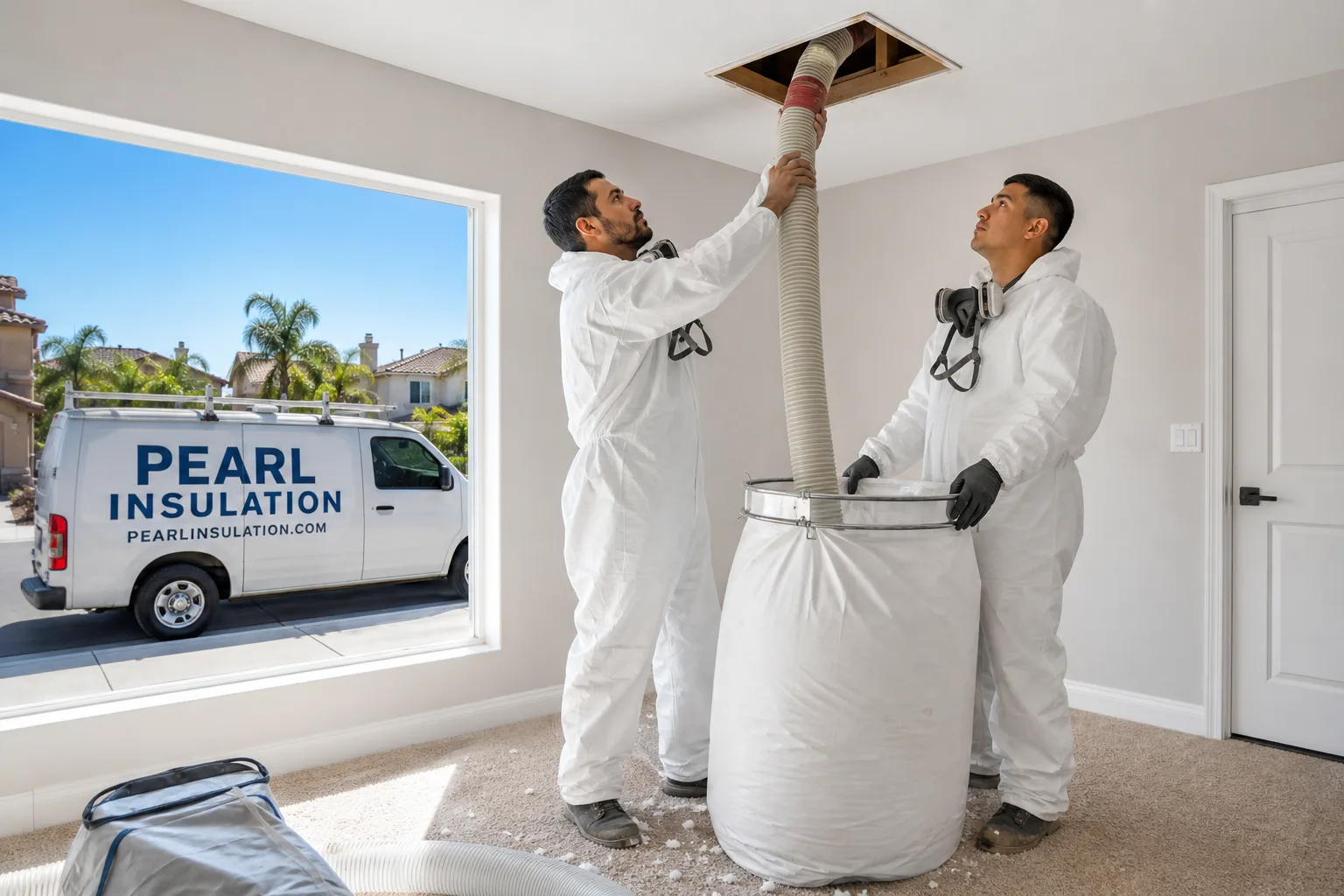
Fast, Reliable Attic Insulation Across Fontana
Attic insulation in Fontana is a different job than it is in coastal cities. Here, the attic is the hottest part of the house for six months of the year, and the work is judged by how well it cuts cooling load and blocks radiant heat gain, not by winter retention. Pearl Insulation works across all four Fontana ZIP codes, 92335 through 92337 plus 92331, with same-week scheduling for most attic projects. We know which south-side tract homes still have original 1950s batts and which north-side two-story stucco houses need air-sealing before insulation can do its job. Call (833) 686-4248 for an estimate from a team that works in Fontana attics every week.
Why Pearl Insulation Is Fontana’s Preferred Attic Insulation Company
Fontana homeowners call us because insulation is the only thing we do. We’re not a general contractor fitting attic work between bathroom remodels. Our Attic Insulation team installs nothing but attic insulation, spray foam, and blown-in cellulose, which means we’ve spent years learning how specific materials fail in specific Fontana homes. Roland Sifuentes built Pearl around one idea: no single insulation product wins every job. That’s why we carry competing brands across every major material category, and why we can tell a homeowner in 92335 that re-blowing cellulose over compressed fiberglass batts outperforms tearing everything out, while telling a homeowner in 92336 that a radiant barrier under the roof deck is the smarter first move than adding R-value.
We respond to Fontana service calls from our Temecula base usually within one to two business days, and our crews know the streets: Arrow Boulevard, Foothill, Sierra Avenue, the older grid south of the 10 and the newer subdivisions north of Summit. That local familiarity matters when we’re judging whether an attic has ventilation problems, failed batts, or both. When you call, you talk to a specialist who has already thought about your house type before we arrive.
Attic Ventilation in Fontana
Attic Ventilation in Fontana is not optional equipment. It is the difference between an attic that runs 140°F on an August afternoon and one that stays closer to 110°F, and in a city where summer highs routinely pass 100°F, that 30-degree spread translates directly into cooling cost and shingle life. Fontana’s inland location sits outside the coastal marine layer, so attics here bake for longer stretches and trap heat faster than homes 40 miles west. Most Fontana attic ventilation work we do involves confirming or upgrading ridge and eave airflow, replacing corroded or blocked vent screens, and sometimes adding powered or passive exhaust in attics that hold heat because of poor original venting. Typical attic ventilation prep and repairs in Fontana run $350 to $900 depending on the roof geometry and the number of bays, with full ridge vent and soffit restoration landing between $1,200 and $2,800 on older south-side homes where original vents were undersized.
When Old South-Fontana Vents Fail
Houses around 92335 built in the 1950s through 1970s often have gable-end vents or small static roof vents sized for a cooler climate than Fontana actually gets. Decades of 100°F cycles plus Santa Ana wind-blown dust means those vents are often partially blocked or corroded. We test attic airflow before and after insulation goes in, because re-blowing insulation over a poorly vented attic just traps more heat under the roof deck.
Ventilation Prep Before New Insulation
On re-blow jobs we recommend confirming the ridge vent pulls air and that soffit vents are not buried by old batts, which is common in Fontana tract homes where original insulation covered the eave channels. Fixing that ventilation before adding insulation keeps the new material performing. It is cheaper to correct vent flow first than to un-do a bad insulation install later.
Radiant Barrier in Fontana
Radiant Barrier in Fontana is often the highest-payback material for a south-facing roof, because the problem here is not just heat conduction through the ceiling, it is radiant heat from a roof deck that has been absorbing sun since morning and radiating into the attic all afternoon. Fontana’s long, cloudless summers make radiant barriers unusually effective compared to coastal cities where marine layer clouds and mild air blunt the effect. On single-story ranch homes with dark composition shingles, a perforated radiant barrier stapled to the underside of the roof deck can cut attic temperatures by 20 to 30 degrees. Radiant barrier installation in Fontana typically runs $1.50 to $2.50 per square foot of attic floor area, so a 1,400-square-foot attic lands between $2,100 and $3,500. On a 2,800-square-foot two-story in 92336, expect $4,200 to $6,500.
When Radiant Barrier Outperforms More Insulation
If an attic already has 12 to 14 inches of blown fiberglass but the house still struggles to hold temperature in summer, the missing piece is usually radiant control, not more R-value. That is a pattern we see in north Fontana subdivisions built in the 1990s and 2000s, where ceilings were insulated to code but the builders skipped radiant barriers entirely. Adding R-38 to R-49 on top of code-level insulation buys little; a radiant barrier buys the larger summer gain for less total cost in those houses.
Radiant Barrier Repair in Older Homes
Many south Fontana homes around 92335 had early radiant-barrier foil installed decades ago, and much of it is torn, dusty, or sagging. When foil degrades, it stops reflecting and starts trapping moisture if ventilation is weak. We replace failed foil rather than layering new material over dead product, because a torn radiant barrier provides none of the intended benefit and sometimes makes humidity worse.
Trusted Brands We Service in Fontana
Pearl Insulation installs insulation from eight manufacturer lines, including Knauf, Rockwool, CertainTeed, and Icynene, so a Fontana homeowner never gets pushed toward a single product because it is the only one we stock. For hot, dry attics around Fontana, we often recommend Knauf blown-in fiberglass or GreenFiber cellulose for re-blow work, and Icynene open-cell spray foam when the attic will be used as conditioned or semi-conditioned space. Rockwool batts come up on south-side homes where fire resistance and attic sound transmission matter alongside thermal performance. We hold local inventory for common Fontana project sizes, which keeps turnaround tight during summer when demand spikes and attics are hottest.
Common Attic Insulation Problems We See in Fontana Homes
- Compressed fiberglass batts in 1950s-70s tract homes. Decades of 100°F+ attic heat cycles gradually flatten fiberglass batts until they lose their loft and their R-value. In south Fontana around 92335, we regularly find batts that have compressed from R-30 to roughly R-15 or less, leaving the ceiling effectively under-insulated even where material is present.
- Torn and degraded radiant-barrier foil. Original foil in older Fontana homes is often ripped, sagging, or coated in dust. Once the reflective surface is dull or torn, it stops returning heat to the roof deck and can trap moisture when ventilation is weak.
- Undersized attic ventilation combined with dark roof shingles. Many Fontana homes have dark composition roofs that absorb enormous sun load, paired with original venting that was never designed for inland heat. The result is a superheated attic that shortens the life of shingles and pushes heat into living space.
- Aging ductwork running through superheated attics. In 1950s-70s tract homes, HVAC ducts often run through attics that hit 130°F or more, and old duct wrap is frequently thin or missing. That means cooled air loses temperature before it reaches the rooms, a loss homeowners often misread as an insulation problem when it is actually a duct-wrap problem made worse by insulation failure.
Pricing for Attic Insulation in Fontana, CA
The two big variables in Fontana are whether we are re-blowing over failed batts or installing a radiant barrier, and which ZIP code the house sits in. Re-blowing loose-fill over compressed batts in a typical 1,200 to 1,600-square-foot south Fontana attic runs $2,900 to $4,400. Full attic insulation replacement where we remove failed batts, air-seal, and re-blow runs $3,800 to $6,200 for that same footprint. Radiant barrier installation adds $2,100 to $3,500 on a 1,400-square-foot attic, and more on larger two-story north-side homes where roof geometry is more involved. Attic ventilation prep and vent replacement sits in the $350 to $900 range for most jobs. Every estimate is free, and our quote includes the specific material we are installing, not a vague line item. Call (833) 686-4248 and we’ll give you a number for your house, not a brochure range.
We Also Serve Cities Near Fontana
Our crews pull from Temecula and run routes through the Inland Empire every week, so we are regularly in Bloomington, Rialto, Glen Avon, and Pedley on the same day as Fontana jobs. If you live near the Fontana city line or just outside it, Fontana service still applies to you. We schedule by route, not by arbitrary city boundaries, so call and ask when we are next in your neighborhood.
Serving Fontana, CA — Our Local Coverage Area
We’re based in the Fontana area and know this community well. Use the map below to see our service coverage — if you’re nearby, we can almost certainly help.
FAQs About Attic Insulation in Fontana
Because the original fiberglass batts in those 1950s-70s houses have compressed under decades of 100°F attic heat until they hold a fraction of their original R-value, and adding new batts on top of compressed ones leaves the same dead air gaps underneath. Re-blowing loose-fill over the failed batts fills those gaps, levels the attic floor to a uniform depth, and restores thermal performance without the labor cost of a full tear-out. In most 92335 attics we inspect, re-blowing is the right economic call. Call (833) 686-4248 and we can tell you which situation your attic is in.
Usually yes, because those homes were built with adequate ceiling insulation but no radiant-barrier foil, and their large south- and west-facing roof planes absorb enormous summer sun. A radiant barrier in that house type cuts attic temperatures by 20 to 30 degrees and takes direct load off the upstairs air handler while costing less than adding another layer of blown insulation. We can inspect the roof orientation and existing insulation to give you a payback estimate in minutes.
Look for compressed batts that sit below the top of the ceiling joists, dust or rodent trails in the material, torn foil draped across bays, or heat that pours into the house within an hour of sunset even though the AC has been running. If upstairs bedrooms in a 92335 ranch home run 8 to 12 degrees warmer than the rest of the house during summer, that is often settled fiberglass plus a failing vent path rather than a simply thin layer. We inspect the attic with a thermal lens and air-flow testing, not guesses.
Confirming the ridge and soffit path actually moves air, replacing corroded vent screens, and adding static or powered exhaust where the roof geometry traps heat. In older south Fontana homes the original vents were often sized for a cooler climate, so upgrading ventilation before or alongside insulation is the single most overlooked attic fix. We measure airflow before we quote anything, so you’re not paying for vent work that will not change the attic temperature.
Yes, and the brand depends on the house, not on what we happen to have in the truck that week. For re-blows over compressed batts in Fontana’s older homes we frequently use GreenFiber cellulose for its density and gap-filling behavior. For new-construction or high-performance retrofits, we install Icynene spray foam. For fire-resistant batt replacement, Rockwool. We carry all of these plus Knauf and CertainTeed, and we’ll explain why one material fits your attic better than another before any work starts. Call (833) 686-4248 for a free estimate and a straight answer about which one your house needs.
Written by Roland Sifuentes, Owner at Pearl Insulation, serving Fontana attic insulation projects from Temecula, CA.