Fast, Reliable Attic Insulation Across Moreno Valley
Attic insulation in Moreno Valley typically costs $1,800 – $4,200 for removal and replacement, and most jobs are completed within one to three days. The bigger question is whether your attic needs a simple top-up or a full removal first. In Moreno Valley’s 1980s – 2000s tract stock, we see far more homes that need removal than homeowners expect. Call us at (833) 686-4248 for a free attic assessment, and we’ll tell you which job actually fits your house.
We know these neighborhoods. The stucco single-story homes off Alessandro Blvd, the ranch-style properties near the older Sunnymead core, the tract developments winding through Towngate and Sunnymead Ranch. Each area was built during a specific window, which means each has its own insulation failure patterns. When we drive out to a home in 92555 or 92557, we already have a good idea what the attic will look like before we climb the ladder. That local familiarity saves you time and gets the fix right on the first visit.
Why Pearl Insulation Is Moreno Valley’s Preferred Attic Insulation Company
Pearl Insulation is a dedicated insulation contractor. We don’t do roofing, HVAC, or general remodeling. Insulation is the only trade we practice, which means our team has seen thousands of Moreno Valley attic configurations and knows exactly how each responds to Riverside County’s heat. That depth matters when you’re deciding between blown-in cellulose, fiberglass batts, or spray foam for a 1990s tract home with a vented wood-truss attic.
We carry eight competing insulation brands: Owens Corning, Johns Manville, Knauf, Rockwool, CertainTeed, Icynene, Demilec, and GreenFiber. Not one brand line. Eight. That lets us recommend what your home actually needs, not what’s easiest for us to source. For a Moreno Valley ranch house with an aging wood-truss attic, we might recommend Knauf batts. For a homeowner who wants fire resistance, Rockwool mineral wool. For an attic that fights 105°F summers, blown-in GreenFiber at R-49. We’d rather explain the tradeoffs honestly than steer every job toward one product.
Led by Roland Sifuentes, our crew works across all four Moreno Valley ZIP codes: 92551, 92555, 92556, and 92557. Typical response time is same-week for most assessments, and we schedule installations around your AC outage concerns, not ours.
Attic Insulation Removal in Moreno Valley
Attic insulation removal in Moreno Valley is the job we recommend most often for homes built before 2005, because decades of 100°F+ attic heat don’t just settle insulation, they compress it into a mat that loses most of its R-value. Homeowners call us thinking they need more insulation, then we open the hatch and find builder-grade R-13 batts mashed to under three inches. Adding new insulation on top of a compacted, contaminated layer just buries the problem. The right fix starts with removal.
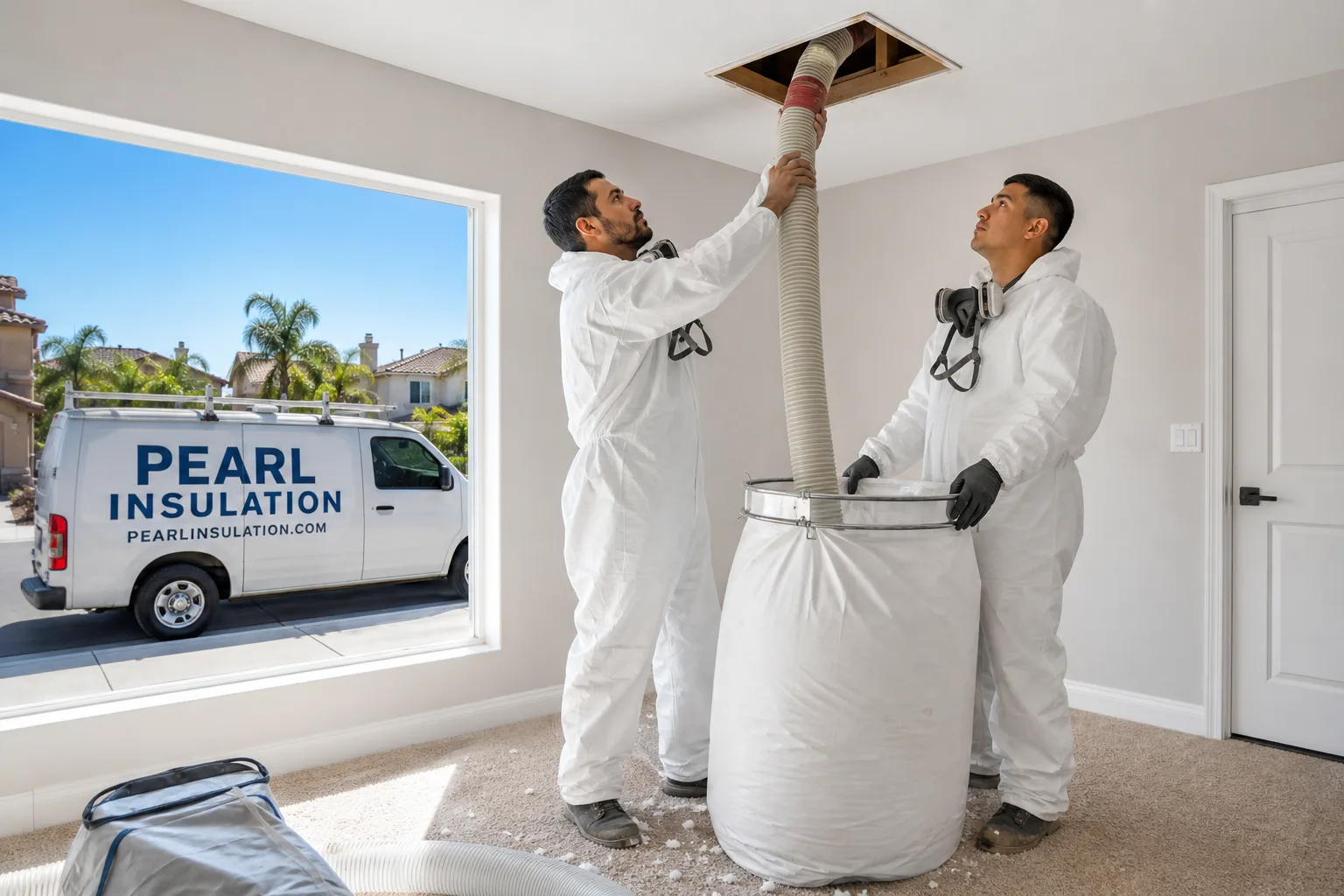
So what does removal involve here? We extract the old material, whether it’s fiberglass batts, loose-fill fiberglass, or cellulose that’s been turned to dust. We then inspect the attic deck for moisture stains, rodent droppings, or mold before any new insulation goes in. In Moreno Valley’s older tract homes, it’s common to find evidence of roof leaks from past winter storms. You want that addressed before fresh insulation hides it for another decade.
Cost for removal in Moreno Valley runs $0.90 to $2.25 per square foot of attic floor, including bagging and haul-off. A typical 1,400-square-foot attic removal lands between $1,300 and $3,100. Larger homes in 92555 with deep attics or steep access constraints may push toward the upper end. We always give a fixed quote before the crew arrives, never an hourly open-ended number.
Full removal vs. top-up
You only need full removal if the existing insulation is compressed, dusty, moldy, or pest-damaged beyond salvage. If the material is dry, clean, and just under-depth, a blown-in top-up over the existing layer is often enough and costs substantially less.
Why Moreno Valley heat makes removal more likely
Attic temperatures in July and August here routinely exceed 140°F. That sustained heat breaks down fiberglass binder resins and turns aged cellulose into dust that settles. A home in San Bernardino may get 15 more usable years from its insulation than the same house in Moreno Valley simply because of that heat difference. It’s not your imagination; your attic is genuinely harder on insulation here.
Insulation Contractors in Moreno Valley
Insulation contractors in Moreno Valley aren’t all the same, and the difference starts with whether insulation is their primary trade or an afterthought bolted onto an HVAC or solar install. Pearl Insulation handles the full range of attic insulation methods: batt installation, blown-in coverage for attic top-ups, spray foam for air-sealing and high-performance retrofits, and removal when the existing layer has failed. That single-trade focus means our crew walks into your attic already knowing what to look for, not learning the trade on your roof deck.
For most Moreno Valley homes, the best value sequence is air-sealing first, then insulation. Top plates, wire penetrations, recessed can lights, and the attic hatch itself all leak conditioned air up into the attic before insulation ever matters. Sealing those first with foam stops the stack effect that pulls hot attic air down into your living space in summer and heated air up through the ceiling in winter. Many Moreno Valley homeowners are surprised how much this stage alone changes upstairs comfort before any new insulation goes in.
New attic insulation after removal
Once the old layer is out and the attic is sealed, we blow in fresh material to R-49, which is code for this climate zone. That’s roughly 16 to 18 inches of fiberglass or 14 to 15 inches of cellulose. For homes with limited attic depth or ducts in unconditioned space, we may recommend batt and blown-in hybrid approaches.
Radiant barrier for west-facing roofs
The most common request we get from Moreno Valley homeowners is adding a radiant barrier to the west-facing roof slope. The afternoon sun bakes that side of the roof in the Inland Empire, and a radiant barrier can drop attic temperatures by 15 to 25°F at the ridge. It’s not an insulation replacement; it’s a supplemental layer that makes your existing insulation more effective.
Trusted Brands We Service in Moreno Valley
Our Attic Insulation team carries a full bench of manufacturer lines so we never have to push one brand onto every house. For Moreno Valley attics, we lean heavily on GreenFiber cellulose for blown-in top-ups and full replacements. The recycled-content material performs well in high-heat conditions and settles less than older loose-fill fiberglass. When a homeowner wants mineral wool, we install Rockwool batts, which hold their R-value in heat better than standard fiberglass and offer real fire resistance for homes in fire-prone Riverside County. And for high-performance or new-construction retrofit work where air-sealing is the real goal, we install Icynene spray foam. CertainTeed and Knauf batts round out our fiberglass options. We don’t stock these brands for show; we stock them because no single product wins every Moreno Valley job.
Common Attic Insulation Problems We See in Moreno Valley Homes
- Compressed batts under HVAC equipment: AC swaps and furnace replacements in 1980s – 2000s tract homes mean installers moved old insulation aside and never put it back. We routinely find R-13 batts crushed flat under air handlers in Sunnymead Ranch, leaving a low-R patch directly above your most conditioned space.
- Sagged or settled loose-fill: Fiberglass and cellulose both lose loft over decades of 100°F+ attic heat. Homes built during the Moreno Valley bedroom-community boom often measure just 3 – 6 inches in the attic when they should have 16 or more.
- Uninsulated attic hatches and top plates: Builders rarely sealed these in the 1980s and 1990s. The attic access panel in an upstairs hallway often leaks more conditioned air than an open window.
- Baking west-facing roofs without radiant barriers: On Towngate and Sunnymead Ranch homes where the roofline faces west, afternoon attic temperatures climb high enough to stress AC systems and shorten insulation lifespan. A radiant barrier on that slope pays back faster than almost any other single upgrade.
Pricing for Attic Insulation in Moreno Valley, CA
Expect the following ranges for homes in Moreno Valley. Attic insulation top-up over existing material: $0.70 – $1.50 per square foot. Full removal plus blown-in replacement to R-49: $2.40 – $3.60 per square foot. Batt installation for new construction or open attic floors: $1.20 – $2.30 per square foot. Air-sealing before insulation: $400 – $1,200 for a typical tract home. Radiant barrier on a west-facing slope: $800 – $2,200 depending on roof size and access. The biggest cost drivers are attic accessibility, existing insulation condition, and whether you choose cellulose, fiberglass, or spray foam. Every quote from us is a fixed price with no surprise line items. Call (833) 686-4248 for a free estimate.
We Also Serve Cities Near Moreno Valley
Pearl Insulation works throughout the Inland Empire. Along with Attic Insulation in Moreno Valley, we serve homes in March Air Force Base, Woodcrest, Colton, and Loma Linda. Each city has its own housing stock quirks, from Woodcrest’s larger custom lots to Colton’s older 1950s-era bungalows, and we adjust our approach accordingly.
Serving Moreno Valley, CA — Our Local Coverage Area
We’re based in the Moreno Valley area and know this community well. Use the map below to see our service coverage — if you’re nearby, we can almost certainly help.
FAQs About Attic Insulation in Moreno Valley
Most Moreno Valley tract homes built between 1980 and 2005 have builder-grade R-13 or R-19 fiberglass batts that are now compressed, sagging, or pest-damaged. Adding new insulation on top of that failed layer doesn’t restore the R-value you think it will, because the bottom layer is no longer performing. We recommend removal when the existing material is less than 5 inches thick, shows signs of moisture or rodent activity, or has been flattened under AC equipment. Call (833) 686-4248 and we’ll tell you honestly whether your attic needs removal or a top-up.
Sustained attic temperatures above 140°F accelerate settling and binder breakdown in fiberglass, which lowers effective R-value over time. Moreno Valley gets more of those extreme heat days than most Riverside County cities, which is why insulation that’s 20 years old here often performs like insulation half its labeled depth. The heat also makes your attic act as a heat sink that keeps radiating into the house after sunset, which is where air-sealing and radiant barriers help alongside new insulation.
Most Moreno Valley homes spend between $2,400 and $3,600 per 1,000 square feet of attic floor for full removal and blown-in replacement to R-49. That includes haul-off, air-sealing key penetrations, and the new material. Smaller attics on single-story ranch homes may come in under that range, while steep or tight attic access can push the quote higher. Free estimates are always available by calling (833) 686-4248.
Yes. The 1970s ranch homes near the older Sunnymead core tend to have shallower roof pitches and tighter attic clearances, which makes blown-in coverage more practical than batt installation. Those attics also often have weak or absent soffit venting, so we may need to add baffles before blow-in work. Newer tract homes in 92555 and 92557 usually have deeper trusses and better venting, so the material choice comes down to budget and whether you want radiant-barrier add-ons.
Yes, a radiant barrier can be stapled to the roof deck or rafters even with blown-in insulation already on the attic floor. The radiant barrier works on the roof plane, not the insulation layer, so there’s no conflict. For west-facing roof slopes in Moreno Valley, a radiant barrier plus existing R-38 or R-49 blown-in is often enough to drop peak attic temperatures noticeably. Call (833) 686-4248 for a free assessment and a fixed quote.
Written by Roland Sifuentes, Owner at Pearl Insulation, serving Moreno Valley and the Inland Empire.