
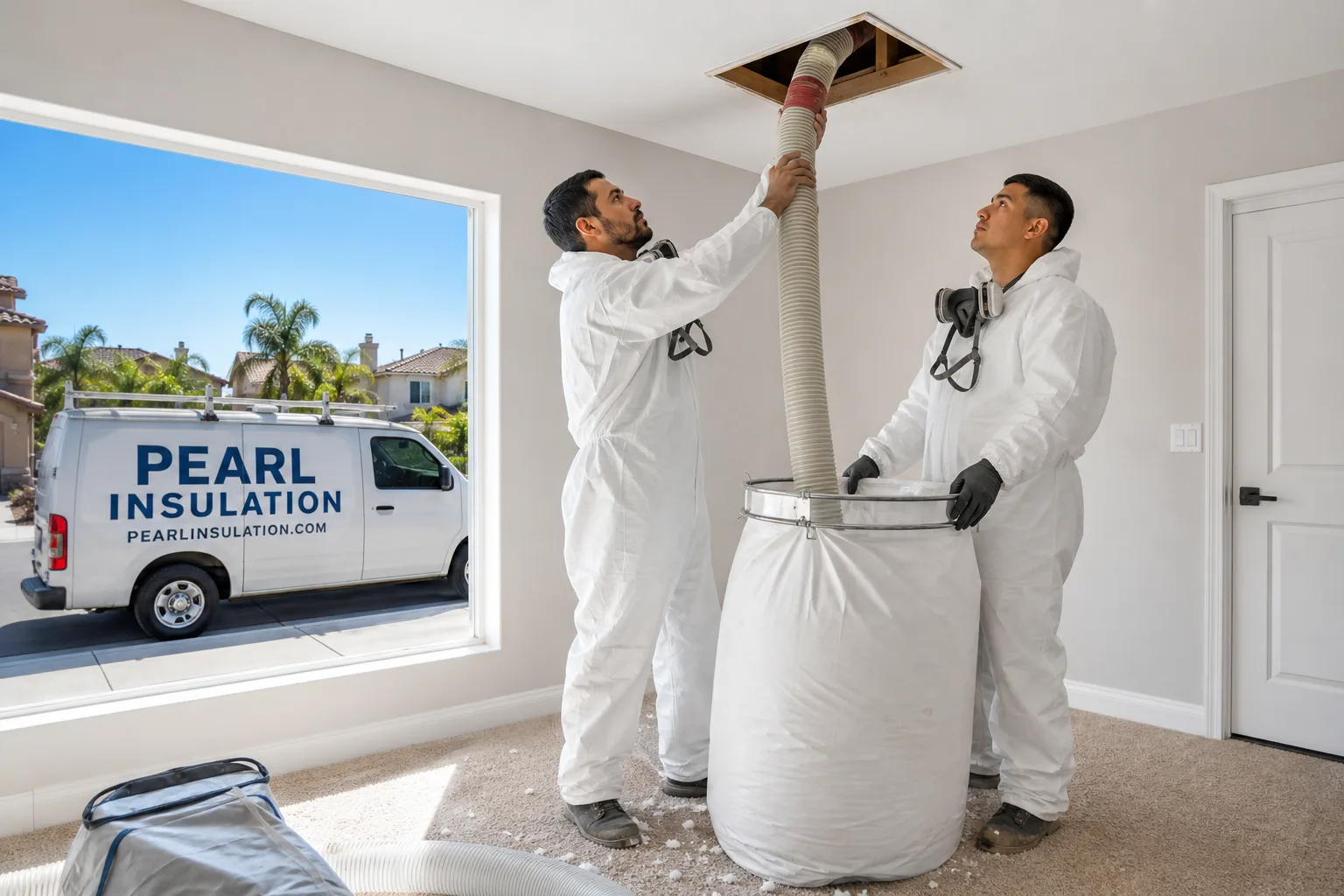
Fast, Reliable Spray Foam Insulation Across Canyon Lake
Spray foam insulation in Canyon Lake typically costs $1.80 to $3.40 per board foot for open-cell and $2.80 to $5.20 per board foot for closed-cell, with most whole-home retrofits landing between $6,000 and $18,000 depending on scope. We reach most Canyon Lake homes within 48 hours for an assessment, and our crews know the gated-entry protocol for every community along Railroad Canyon Road and Canyon Lake Drive North. If your west-facing rooms heat up like an oven by 3 p.m. or your AC can’t keep pace from June through September, call Pearl Insulation at (833) 686-4248. We’ll bring a thermal camera and show you exactly where your home is losing the fight against Canyon Lake’s inland heat.
Why Pearl Insulation Is Canyon Lake’s Preferred Spray Foam Insulation Company
Roland Sifuentes built Pearl Insulation as a single-trade company: insulation only. That means when we show up at a home off Longhorn Drive or a cove-side property on Blue Bird Drive, we aren’t juggling roofing, HVAC, or remodeling scopes. We’re focused entirely on air sealing, R-value, and thermal envelope performance. Canyon Lake homeowners call us because we carry eight manufacturer lines, including Icynene and Demilec spray foam systems, and we don’t have a financial incentive to push one brand over another. The right material for your home’s specific situation is the one we recommend, not whichever product our markup favors.
Our response time to Canyon Lake is consistently same-week, and in summer months we prioritize west-facing heat complaints. The gated access is part of the job, not a hurdle. We’ve completed spray foam retrofits on Redwood Lane, Windmere Drive, and across the east side near Canyon Lake Middle School, and our office coordinates gate clearance before the crew ever leaves Temecula. That’s what local expertise means here: knowing the difference between a 1970s custom build with open-beam ceilings and a 2000s stucco tract home with a conventional attic, before we ever park the truck.
Spray Foam Wall Insulation in Canyon Lake
Spray Foam Wall Insulation in Canyon Lake is a retrofit that rewrites how your home handles western exposure. On the older homes along Canyon Lake Drive South and the cove-side streets, the original wall cavities often hold fiberglass batts that were undersized from day one or have settled badly over 40-plus years. Open-cell spray foam applied into those stud cavities fills every gap, including around electrical boxes and plumbing penetrations, creating an air seal that fiberglass can’t match. A typical wall cavity retrofit in Canyon Lake runs $2,200 to $6,500 depending on the number of exterior walls we treat and whether we’re working around existing drywall or doing the work during a remodel.
Open-Cell Foam for 2×4 Wall Cavities
Many original Canyon Lake homes were framed with 2×4 exterior walls, which leaves roughly 3.5 inches of cavity depth. Open-cell foam at that depth delivers about R-13 to R-15, but the real payoff is air sealing, and in a lakeside climate where humidity sneaks into every gap, stopping air movement matters more than adding R-value to a leaky cavity.
Closed-Cell for Uninsulated Stucco
Some east-side and north-side Canyon Lake tract homes have stucco exteriors with little or no cavity insulation. Closed-cell spray foam at 2 inches adds R-13 plus a vapor barrier in one pass, which is why we like it for tackle walls and lake-facing elevations in Canyon Lake where sun exposure and humidity combine aggressively.
Rim Joist Spray Foam in Canyon Lake
Rim Joist Spray Foam in Canyon Lake targets one of the least-sealed points in any framed house: the band joist where your floor framing meets the foundation. In Canyon Lake’s original 1970s homes, rim joists were often left completely unsealed, and on lakeside lots with humid air pushing into the crawl space or basement, that gap becomes a moisture highway into the envelope. We spray closed-cell foam directly onto the rim joist bays, which seals the air and blocks the moisture transfer in one application. A full rim joist treatment on a typical Canyon Lake single-story or two-story home runs $1,800 to $4,200, depending on linear footage and access.
Why Rim Joists Matter on Lake Lots
Canyon Lake humidity doesn’t stop at the waterline. It moves through the soil and into the under-floor space, then gets drawn upward through every unsealed rim joist. Sealing those bays with closed-cell foam stops that stack effect, which also takes pressure off your HVAC system from the bottom of the house.
What We Find in 1970s Framing
On many original Canyon Lake builds, the rim joist cavities still hold nothing but the original fiberglass friction-fit pieces, which have long since sagged or fallen out. We remove the failed material, clean the bays, and apply closed-cell foam to create a continuous air and moisture barrier at the framing line.
Trusted Brands We Service in Canyon Lake
Pearl Insulation is an authorized installer for Icynene, Demilec, Rockwool, Knauf, and CertainTeed, among eight total manufacturer lines. For Canyon Lake customers, that matters in practical terms: we can bring the right product for the job rather than forcing one system into every situation. Icynene open-cell is our go-to for vaulted cathedral ceilings where air sealing is the priority. Demilec closed-cell handles rim joists and moisture-exposed assemblies. Rockwool gives us a fire-resistant option when a Canyon Lake homeowner wants mineral wool instead of foam. We stock materials at our Temecula location and stage what’s needed before the crew heads to the gate, so turnaround is fast and we aren’t making a second trip because the wrong product got loaded.
Common Spray Foam Insulation Problems We See in Canyon Lake Homes
- Compressed fiberglass in west-facing cathedral ceilings: On original lakefront and cove-side builds from the 1970s and early 1980s, the batts above the open-beam ceilings often sag under their own weight or were compressed during construction. The result is a bright hot band on thermal imaging exactly where the afternoon sun hits the vault, and rooms below become unbearable by late afternoon.
- Lake humidity inside unvented vaulted assemblies: Canyon Lake’s year-round humidity finds its way into ceiling cavities that were never properly vented. Condensation forms against the deck, the insulation loses performance, and in the worst cases you get streaking or musty smells.
- Unsealed original rim joists: Homes built before air-sealing was standard practice have open band joists that let hot, humid air into the floor system. If your floors feel hot in July or your AC runs constantly with rooms that never quite cool, the rim joist is often the culprit.
- Newer tract homes with minimal wall insulation depth: Some 1990s and 2000s stucco homes east of Canyon Lake were built to minimum code standards, meaning wall cavities have thin or poorly fitted batts. Closed-cell spray foam retrofit adds real R-value and air sealing in the same pass, which is why it’s the most requested upgrade on those elevations.
Pricing for Spray Foam Insulation in Canyon Lake, CA
Here’s what you can expect in Canyon Lake’s current market. Open-cell spray foam runs $1.80 to $3.40 per board foot. Closed-cell runs $2.80 to $5.20 per board foot. A rim joist treatment typically lands between $1,800 and $4,200. A full wall cavity retrofit runs $2,200 to $6,500 per project. A cathedral ceiling retrofit on a west-facing vault ranges from $3,500 to $9,500 depending on access, deck condition, and whether we remove the old fiberglass or spray over it. Garage ceiling spray foam runs $1,400 to $3,200. Spray foam roof deck applications run $4,200 to $9,800. The price differences come down to access, prep work, and product choice. Call us at (833) 686-4248 for an exact quote. Estimates are free, and we’ll tell you honestly whether spray foam is the right call or if blown-in insulation makes more sense for your situation.
We Also Serve Cities Near Canyon Lake
Pearl Insulation handles spray foam work across the surrounding Riverside County area, including Meadowbrook, Sedco Hills, Lakeland Village, and Quail Valley. If you’re in one of those communities and want a specialist who understands how this region’s summer heat and lake humidity affect insulation performance, see our full Spray Foam Insulation services or call us at (833) 686-4248. We’ll tell you what’s actually going on in your walls before we recommend a single product.
Serving Canyon Lake, CA — Our Local Coverage Area
We’re based in the Canyon Lake area and know this community well. Use the map below to see our service coverage — if you’re nearby, we can almost certainly help.
FAQs About Spray Foam Insulation in Canyon Lake
No. Spray foam must bond directly to the roof deck or wall sheathing to work properly. If old fiberglass batts are compressed, sagging, or damp from lake humidity, we remove them first, clean the cavity, and then apply spray foam directly to the deck. This is exactly what we did on a 1978 custom home on Canyon Lake Drive North where the original fiberglass had failed in the west-facing vault. Leaving old batts in place creates a thermal break between the foam and the deck, and it also hides moisture problems. Call us for a free assessment and we’ll scope it properly.
West-facing walls in Canyon Lake absorb the brunt of the afternoon sun with summer highs routinely over 100°F and strong, low-angle solar gain from about 2 p.m. until sunset. On older homes with original fiberglass or empty wall cavities, that heat pours through the wall and drives up indoor temperatures. Spray foam, especially closed-cell, both insulates and stops air movement through the cavity, which cuts the heat transfer dramatically. For Canyon Lake homeowners whose west-facing rooms are consistently 8 to 12 degrees hotter than the rest of the house, this is the single most effective retrofit we do. Call (833) 686-4248 and we’ll bring a thermal camera to show you the exact problem areas.
Your best option is to seal the vaulted assembly with spray foam rather than trying to retrofit vents. An unvented cathedral ceiling needs an air-impermeable insulation layer at the deck to work, and open-cell spray foam from Icynene or Demilec does that job. In Canyon Lake’s climate, where lake humidity is high but attic heat is the real enemy, converting an unvented vault to a properly sealed spray foam assembly is the most reliable fix. We see this exact condition on lakefront and golf-course view homes where the vault follows the roofline and there’s no practical way to add ventilation.
Closed-cell spray foam acts as both an air barrier and a vapor retarder, which means it prevents humid lake air from moving into wall and ceiling cavities where it condenses against cooler surfaces. In Canyon Lake, where the lake keeps the air humid year-round, that matters in every wall, rim joist, and vaulted ceiling we treat. Open-cell foam is air-permeable but still seals air leaks, so it reduces humidity transfer significantly even if it doesn’t act as a vapor barrier. For rim joists and water-adjacent elevations, we typically recommend closed-cell for this reason.
Yes, and in many cases it’s the highest-impact upgrade you can make on an original Canyon Lake home. Those 1970s builds were often framed with 2×4 walls, unsealed rim joists, and cathedral ceilings with fiberglass batts that have long since compressed or failed. Removing the old batts and applying spray foam to the deck and rim joists produces a measurable difference in comfort and cooling costs. We recently sprayed an open-cell retrofit in a 1978 home on Canyon Lake Drive North, and the homeowner noticed a dramatic drop in afternoon heat gain within the first week. Call (833) 686-4248 for a free estimate and we’ll assess your specific ceiling and wall conditions.
Written by Roland Sifuentes, Owner at Pearl Insulation, serving Canyon Lake and the surrounding Riverside County area.