
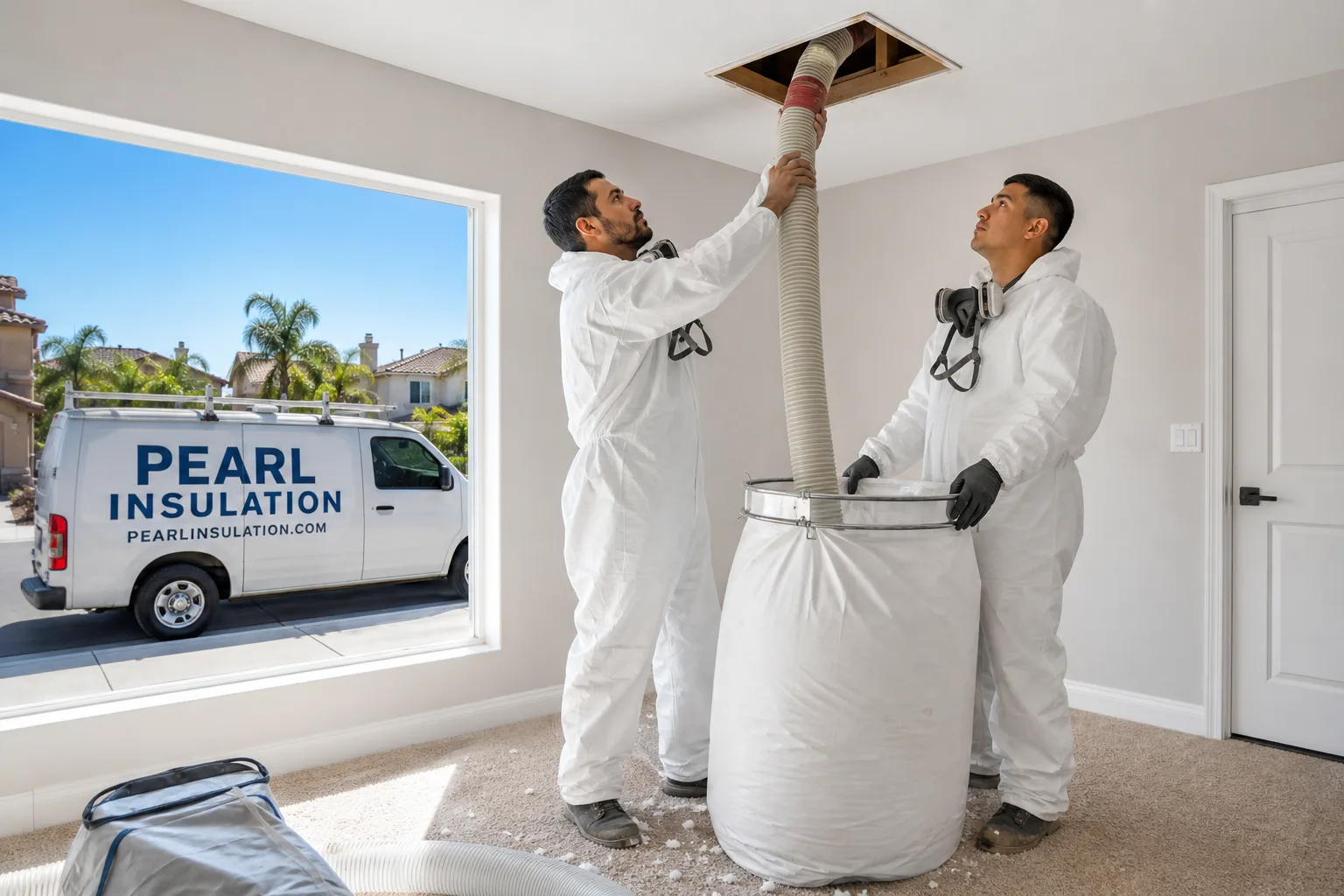
Fast, Reliable Spray Foam Insulation Across Highland
Spray foam insulation in Highland typically costs $2.50 to $6.50 per board foot installed, with most attic deck projects in the 92346 ZIP running $4,200 to $9,800 depending on square footage and foam type. We get crews to Highland homes within 24 to 48 hours for estimates, and same-week installation is common during spring and fall. If your attic hits 150°F by noon and your AC runs nonstop from June through September, the problem isn’t your HVAC – it’s heat pouring through an under-insulated roof deck. Call (833) 686-4248 and we’ll scope the job based on your specific block, not a citywide formula.
Why Pearl Insulation Is Highland’s Preferred Spray Foam Insulation Company
Highland homeowners call us because we carry both Icynene and Demilec, two open- and closed-cell spray foam systems most local installers don’t stock. That matters when a 1970s tract home near Base Line needs a different foam than a newer foothill-edge build with 20-foot ceilings. Roland Sifuentes built Pearl Insulation around a simple idea: carry competing brands because no single product wins every job. We don’t steer every Highland home toward one foam formula. We look at sun exposure, attic volume, dust intrusion, and your cooling bills, then match the material to the structure.
Our crews know the 92346 ZIP block by block. Homes off Greenspot Road near the valley floor face different afternoon heat than houses climbing toward the foothill margins off Weaver Street. That local knowledge changes how we scope rim joists, roof decks, and crawl spaces. We’re a single-trade insulation contractor – spray foam, attic insulation, and blown-in. That focus means fewer handoff errors and deeper product knowledge than a general contractor juggling five trades.
Crawl Space Spray Foam Insulation in Highland
Crawl space spray foam insulation in Highland is one of the most overlooked fixes for homes that feel drafty in winter and humid in summer, especially on the valley floor where older 1950s and 1960s tracts sit closer to groundwater. We spray closed-cell foam against crawl space walls and rim joists to block air movement, stop dust from sifting in through vent gaps, and keep floorboards warmer when winter nights dip into the 40s. Most Highland crawl space jobs run $2,800 to $6,500 for a full perimeter seal.
Rim Joist Sealing
The rim joist is where your floor framing meets the foundation, and in Highland it’s a prime entry point for wind-blown sand from the foothill margins. We spray a 2-inch closed-cell layer across the entire rim band, which cuts stack-effect air movement and keeps conditioned air from leaking out through the band joist. This is often the highest-ROI spray foam job in older Highland homes because the material cost is low but the air-sealing payoff is immediate.
Floor Deck Underside
For raised foundations over vented crawl spaces, we often recommend spraying the floor deck underside with open-cell foam. It deadens footfall noise and stops cold floors in winter without trapping moisture against the subfloor. In Highland’s dry climate this works well because the crawl space rarely holds standing humidity the way coastal crawl spaces do.
Garage Spray Foam Insulation in Highland
Garage spray foam insulation in Highland turns a punishing mid-summer oven into a usable workspace, especially for attached garages that share a wall with living space. We spray the garage ceiling and shared interior wall with open-cell foam to stop heat from the garage roof deck bleeding into bedrooms above or beside it. A typical single-car garage ceiling in Highland runs $1,400 to $2,600; a two-car garage with shared wall runs $2,400 to $4,200.
Garage Ceiling and Shared Wall
Most Highland tract homes have the garage under a section of attic that bakes all afternoon. By foaming the garage ceiling to R-19 or better and the shared wall to R-13, we cut heat transfer into the house enough that many homeowners notice the adjacent bedroom stays 4 to 7 degrees cooler. That’s the difference between an AC that cycles and one that runs flat-out from 2 p.m. to 8 p.m.
Detached Garage Conversions
For detached garages Highland homeowners use as workshops or home gyms, closed-cell foam on the walls and roof deck works as both thermal barrier and structural stiffener. In wind-prone foothill locations, that extra rigidity helps the building shrug off gusts that rattle uninsulated metal and frame construction.
Trusted Brands We Service in Highland
Pearl Insulation is an authorized installer for Icynene and Demilec, two open- and closed-cell spray foam lines specified in high-performance residential work. We also carry Rockwool mineral wool for Highland homeowners who want a fire-resistant alternative with strong sound control – useful on shared walls and garage conversions. Because we stock competing products, we can be honest about which foam fits your home’s age, sun exposure, and budget. Parts and material for Highland jobs are staged from our Temecula yard, so we’re not waiting on a distributor to ship before we can start.
Common Spray Foam Insulation Problems We See in Highland Homes
- Dust-choked attic insulation: Decade after decade, wind-blown sand from the foothill margins of 92346 sifts through unsealed top plates, can lights, and vent penetrations, settling into the original insulation. By the time we open the attic, the batts are often more dust than fiber.
- Roof deck foam without air sealing: Some Highland homeowners paid for spray foam on the roof deck, but the installer skipped sealing top plates and can lights first. Result: hot attic air and sand bypass the foam entirely, and the cooling bill doesn’t drop.
- Thin or uneven foam in high-volume attics: Newer foothill-edge homes with 18- to 22-foot attic volumes need a measured, even lift. Foam sprayed too thin leaves radiant heat gain largely unblocked on 100°F+ afternoons.
- Ignored rim joists: In raised-foundation homes on the valley floor, unsealed rim joists let sand and hot air pour into the crawl space, which then works its way up through wall cavities. Closed-cell rim sealing is the fix most of these houses never got.
Pricing for Spray Foam Insulation in Highland, CA
Here’s what we see in the 92346 market. Attic roof deck spray foam runs $2.50 to $4.50 per board foot for open-cell and $3.50 to $6.50 for closed-cell, with most Highland roof decks landing between $4,200 and $9,800 total. Crawl space perimeter sealing with closed-cell runs $2,800 to $6,500. Garage ceilings run $1,400 to $4,200 depending on size and shared-wall work. Rim joist sealing alone often comes in under $1,800. What moves the number: attic square footage, foam depth required, accessibility, and whether we’re air-sealing penetrations first (you should). Call (833) 686-4248 for a free estimate – we’ll walk your attic with you and price the exact scope, not a range sheet.
We Also Serve Cities Near Highland
Pearl Insulation’s Spray Foam Insulation crews work across the eastern Inland Empire. If you’re in Highland or one of the surrounding communities – San Bernardino, Redlands, Loma Linda, or Mentone – the same material-agnostic approach applies. Response times run 24 to 48 hours for estimates anywhere in the corridor, and larger projects in neighboring cities are often scheduled the same week as Highland jobs.
Serving Highland, CA — Our Local Coverage Area
We’re based in the Highland area and know this community well. Use the map below to see our service coverage — if you’re nearby, we can almost certainly help.
FAQs About Spray Foam Insulation in Highland
Because Highland attics bake past 150°F by midday in summer, and batt insulation slows heat but doesn’t stop air movement. Spray foam seals the roof deck itself, blocking both radiant heat gain and the wind-driven dust that sifts through unsealed penetrations. For 100°F+ summers, air sealing plus deck foam beats deeper batts every time. Call (833) 686-4248 to scope your attic.
Yes, often. Valley-floor homes near Greenspot Road or Base Line tend to have older attics with settled insulation and more air leakage at penetrations, so air sealing drives the scope. Newer foothill-edge homes off Weaver Street or Highland Avenue have bigger attic volumes and need a measured, even foam lift to actually block radiant heat. We price each job against the home, not a zip-code average.
Yes, and this is the most underrated benefit in Highland. Closed-cell foam applied to rim joists, top plates, and can-light penetrations physically blocks the gaps where wind-blown sand enters. On one 1970s stucco tract home off Base Line near the foothill edge, our crew found the original attic insulation thin, settled, and dust-choked where sand had sifted through unsealed top plates. We air-sealed those penetrations first, then sprayed Icynene to the roof deck underside. The attic stopped baking past 150°F by midday and the HVAC kept up on 100°F+ afternoons.
We install Icynene and Demilec spray foam systems, and stock Rockwool mineral wool for Highland homeowners who prioritize fire resistance or sound control. Because we carry competing brands, the recommendation follows your home’s sun exposure, attic volume, and budget – not what’s cheapest for us to source. Free estimates at (833) 686-4248.
In most Highland tract homes, yes – the attached garage is a principal heat source for adjacent bedrooms, and the crawl space is a dust and air entry point. Foaming the garage ceiling and shared wall typically costs $1,400 to $4,200; a crawl space perimeter seal runs $2,800 to $6,500. We’ll tell you which one pays back fastest in your specific house, and we won’t upsell what you don’t need.
If your Highland home’s attic is dust-choked, your energy bills climb every summer, or your AC can’t keep pace on 100°F+ afternoons, call Pearl Insulation at (833) 686-4248. We’ll walk the attic, explain your foam options in plain terms, and give you a free, line-item estimate. Roland Sifuentes and our team serve Highland from our Temecula yard with 24 to 48-hour estimate response times.
Written by Roland Sifuentes, Owner at Pearl Insulation, serving Highland and the eastern Inland Empire with spray foam, attic, and blown-in insulation.