
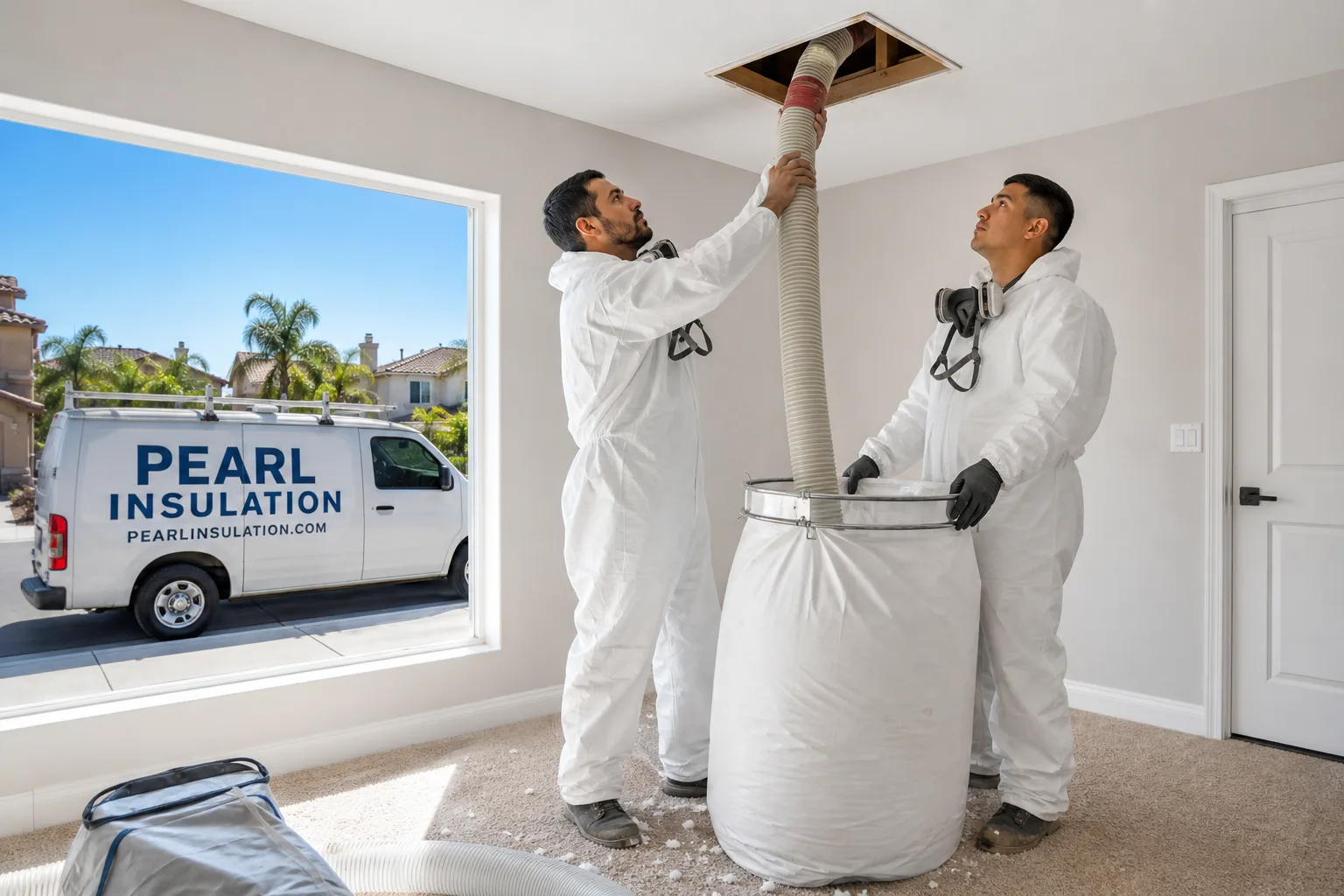
Fast, Reliable Spray Foam Insulation Across Wildomar
Spray foam insulation in Wildomar targets a problem most homeowners don’t realize they have until August: their west-facing garage ceiling baking in the afternoon sun and pushing that heat straight through the shared wall into the living room. Pearl Insulation fixes that specific heat path with closed-cell Icynene and Demilec spray foam, air sealing, and top-plate work tailored to Wildomar’s 1980s and 1990s stucco tracts. Roland Sifuentes leads our team, and he’s spent enough afternoons in Wildomar attics to know exactly what these homes need. Call (833) 686-4248 for a free estimate, and we’ll walk your property the same week.
Why Pearl Insulation Is Wildomar’s Preferred Spray Foam Insulation Company
We’re an insulation-only contractor. That’s not a marketing line, it’s how we’re built. While general contractors juggle roofing and drywall and a dozen other trades, Pearl Insulation focuses on one thing: getting the right material into the right part of your home’s thermal envelope. For Wildomar homeowners that focus matters because the failure mode here is specific. Original R-11 and R-13 batts sag over 1980s and 1990s stucco ceilings, top plates stay leaky, and uninsulated garage ceilings radiate heat into living spaces every afternoon from May through October.
Our Spray Foam Insulation team carries both Icynene and Demilec spray foam systems, the two brands most often specified in high-performance residential builds. That gives Wildomar customers access to something most local installers don’t have: a genuine choice between open-cell and closed-cell chemistry, matched to the assembly rather than the installer’s habit. We also stock Rockwool and CertainTeed for jobs where spray foam isn’t the right tool, because no single product wins every job. If your home needs mineral wool fire resistance or a hybrid approach, we’ll tell you that too.
Garage Spray Foam Insulation in Wildomar
Garage Spray Foam Insulation in Wildomar is the highest-leverage spray foam job we do, because the dominant heat path in this city runs through the garage ceiling and the shared wall between garage and living room, not through the attic deck. Wildomar’s 1980s through 2000s single-story stucco tracts were built with attached garages on the west or southwest side of the lot. Those garages get baked by low afternoon sun on low-pitch tile or shingle roofs. Attic and garage temperatures routinely pass 140°F by mid-afternoon. Closed-cell spray foam applied to the garage ceiling and the shared knee-wall blocks radiant gain at the source, so your living room stops absorbing heat at 4 p.m.
What the job involves in Wildomar: we remove the drywall or work from the garage attic access, spray a continuous air and thermal barrier on the ceiling plane, seal the top plates where the garage frame meets the house, and address any shared-wall penetrations. A typical garage ceiling in a Wildomar 1990s tract runs $2,400 to $4,200 depending on ceiling area and whether we’re also sealing the shared knee-wall. Homes in The Farm and Windsong subdivisions with larger three-car garages land at the upper end.
Closed-cell on the shared wall
The shared wall between an unconditioned garage and a conditioned living room is typically a code minimum wall with no insulation value to speak of. Spraying closed-cell foam on the garage side of that wall, from stud to stud, creates a thermal break that most of these homes never had. In Rancho Vista and along Grand Avenue we see this one fix drop living room wall temperatures by 15 to 20 degrees on hot afternoons.
Air sealing the top plates
One detail most insulation crews skip in Wildomar is the top plate band where the garage framing meets the house. Those top plates almost never got sealed when these tract homes were built. We foam-seal every linear foot before we insulate the ceiling plane. Without that seal, you’re still pulling hot attic air into the wall cavity even with new foam overhead.
Crawl Space Spray Foam Insulation in Wildomar
Crawl Space Spray Foam Insulation in Wildomar is a smaller part of our local work because most Wildomar homes sit on concrete slabs. But around Lakeland Village, parts of Sedco Hills, and a handful of custom lots east of I-15, raised foundations and crawl spaces do exist. For those homes the relevant problem is not Wildomar’s afternoon heat but the moisture and air movement that moves up from the soil. In the Temecula Valley’s dry inland climate that might sound counterintuitive, but irrigation runoff and winter rains still wet the ground under these floors. Open-cell Icynene spray foam on the crawl space walls and rim joists stops that air path and keeps the floor above noticeably warmer in winter.
Cost for crawl space spray foam in the Wildomar area runs $3,800 to $7,500 depending on the square footage of the crawl and how much rim joist work is involved. It’s a targeted fix, and we’ll tell you plainly if your slab-on-grade home doesn’t need it.
Rim joist spray foam
The rim joist is the band around the edge of the floor frame where the joists meet the foundation wall. It’s the single leakiest seam in most raised foundations. Spraying closed-cell foam on the rim joists and sealing the sill plate cuts the stack effect pulling soil air into the house. We do this as a standalone job for homeowners who aren’t ready to insulate the full crawl.
Crawl space wall foam vs. floor batts
If your goal is stopping the cold-floor-in-winter problem, spraying the crawl space walls works better than batting the floor joists. The foam on the walls turns the crawl into a semi-conditioned buffer zone. Floor batts sag, trap moisture against the subfloor, and don’t stop rim joist air leaks. We carry both options, but for most raised foundations around Wildomar the wall spray is the right call.
Trusted Brands We Service in Wildomar
Pearl Insulation is an authorized installer of Icynene and Demilec spray foam, the two brands you’ll find specified on high-performance and new-construction builds across Southern California. We also install Rockwool and CertainTeed for hybrid assemblies where spray foam isn’t the full answer. We stock the local Wildomar jobs ahead of time when we know the home, so turnaround is fast, typically under a week from estimate to install for garage and attic work. Built on brands the industry trusts, our recommendation follows your home’s construction and your goals, not our inventory sheet. If spray foam isn’t the right material for your Wildomar home, we’ll tell you and quote the mineral wool or batt alternative instead.
Common Spray Foam Insulation Problems We See in Wildomar Homes
- Original R-11 and R-13 attic batts sagging over stucco ceilings. These 1980s and 1990s tracts were built to minimum code, and three decades of thermal cycling compress the batts until they lose most of their R-value. The top plates underneath were never sealed, so 140°F attic air pulls right into the conditioned rooms.
- Uninsulated garage ceilings heating the shared living-room wall. West-facing garages in The Farm and Windsong tracts turn into radiant heaters every afternoon. The drywall ceiling does nothing to stop the heat, and the shared wall has no thermal break. This one problem drives more of our Wildomar spray foam calls than any other.
- Closed-cell sprayed over low-slope roofs without sealing knee walls or top plates. We see this from previous installs where a crew sprayed the roof deck but never addressed the knee-wall or top-plate leaks. The foam traps heat and moisture in the assembly instead of blocking radiant gain, and the homeowner sees little improvement.
- Garage-to-living-room wall penetrations left unsealed. Wire runs, plumbing chases, and can lights in the shared wall let hot garage air pour into the living space even when the garage ceiling is insulated. We seal every penetration with foam before closing up the job.
Pricing for Spray Foam Insulation in Wildomar, CA
What you’ll pay depends on the assembly, not just the square footage. Garage ceiling spray foam in a standard Wildomar two-car garage runs $2,400 to $4,200. Full attic spray foam with top-plate air sealing in a 1,800-square-foot single-story stucco home runs $6,500 to $10,500. Crawl space work, where it applies, runs $3,800 to $7,500. Rim joist spray foam as a standalone job runs $1,600 to $3,000. Closed-cell costs more per board foot than open-cell, but most Wildomar garage and attic jobs call for closed-cell because we’re blocking radiant heat, not just slowing air movement. Call (833) 686-4248 for a free estimate and we’ll give you an exact number for your address, no vague ranges at contract time.
We Also Serve Cities Near Wildomar
Pearl Insulation works throughout the Temecula Valley. We serve Wildomar plus Murrieta, Murrieta Hot Springs, Sedco Hills, and Lakeland Village, with the same one-trade focus and manufacturer-authorized installation on every job. If you’re just over the city line, call (833) 686-4248 and we’ll route a crew your way.
Serving Wildomar, CA — Our Local Coverage Area
We’re based in the Wildomar area and know this community well. Use the map below to see our service coverage — if you’re nearby, we can almost certainly help.
FAQs About Spray Foam Insulation in Wildomar
Because your heat problem is radiant gain through the garage ceiling and leaky top plates, not cold-weather heat loss through the attic floor. Adding more batts over an already failing assembly doesn’t stop the 140°F attic air pulling through unsealed top plates. Spray foam air-seals as it insulates. In a 1990s single-story stucco home in Wildomar, closed-cell foam on the garage ceiling and top plates addresses the actual failure mode. Call (833) 686-4248 for an estimate on your specific tract.
Yes, it’s the single most effective fix we do in Wildomar for exactly that symptom. The west-facing garage roof absorbs solar heat all afternoon, and the uninsulated ceiling radiates it into the garage. The shared wall then conducts that heat into the living room. Closed-cell spray foam on the garage ceiling plane, plus air sealing on the shared knee-wall and top plates, breaks that heat path. We’ve done this in Rancho Vista and Windsong homes and seen the living room wall cool down the same day. Call (833) 686-4248 and we’ll walk your garage and give you a straight quote.
Closed-cell, in nearly every Wildomar case. Closed-cell foam has roughly twice the R-value per inch and, more importantly for this climate, its density blocks radiant heat transfer through the material itself. Inland Temecula Valley summers push attic temperatures well past 140°F, and open-cell foam simply doesn’t block radiant gain the way closed-cell does. There are mild exceptions for interior walls and sound control, but for garage ceilings and top plates we specify closed-cell Icynene or Demilec. Call (833) 686-4248 and we’ll explain the difference in the context of your home’s specific construction.
Yes, in most cases you want the compressed, dust-loaded batts pulled out before we spray. Leaving them in place creates an irregular surface and keeps the old fiberglass from doing anything except trapping dust and moisture. For attic jobs we remove the old batts, air-seal the top plates and penetrations, then spray the foam to the specified depth. It’s the only way to get a continuous air barrier. Call (833) 686-4248 for a removal-and-respray quote specific to your home’s attic.
No, and we’ll tell you that plainly. The majority of Wildomar’s 1980s to 2000s tract housing sits on concrete slabs, so there is no crawl space to insulate. If you have a raised foundation, typically found around Lakeland Village and parts of Sedco Hills, then crawl space spray foam on the walls and rim joists does make sense for stopping soil air movement and cold floors. If you’re slab-on-grade, your money is better spent on garage ceiling foam and top-plate sealing. Call (833) 686-4248 and we’ll confirm what your foundation actually is before recommending anything.
Written by Roland Sifuentes, Owner at Pearl Insulation, serving Wildomar and the Temecula Valley with manufacturer-authorized spray foam installation.