
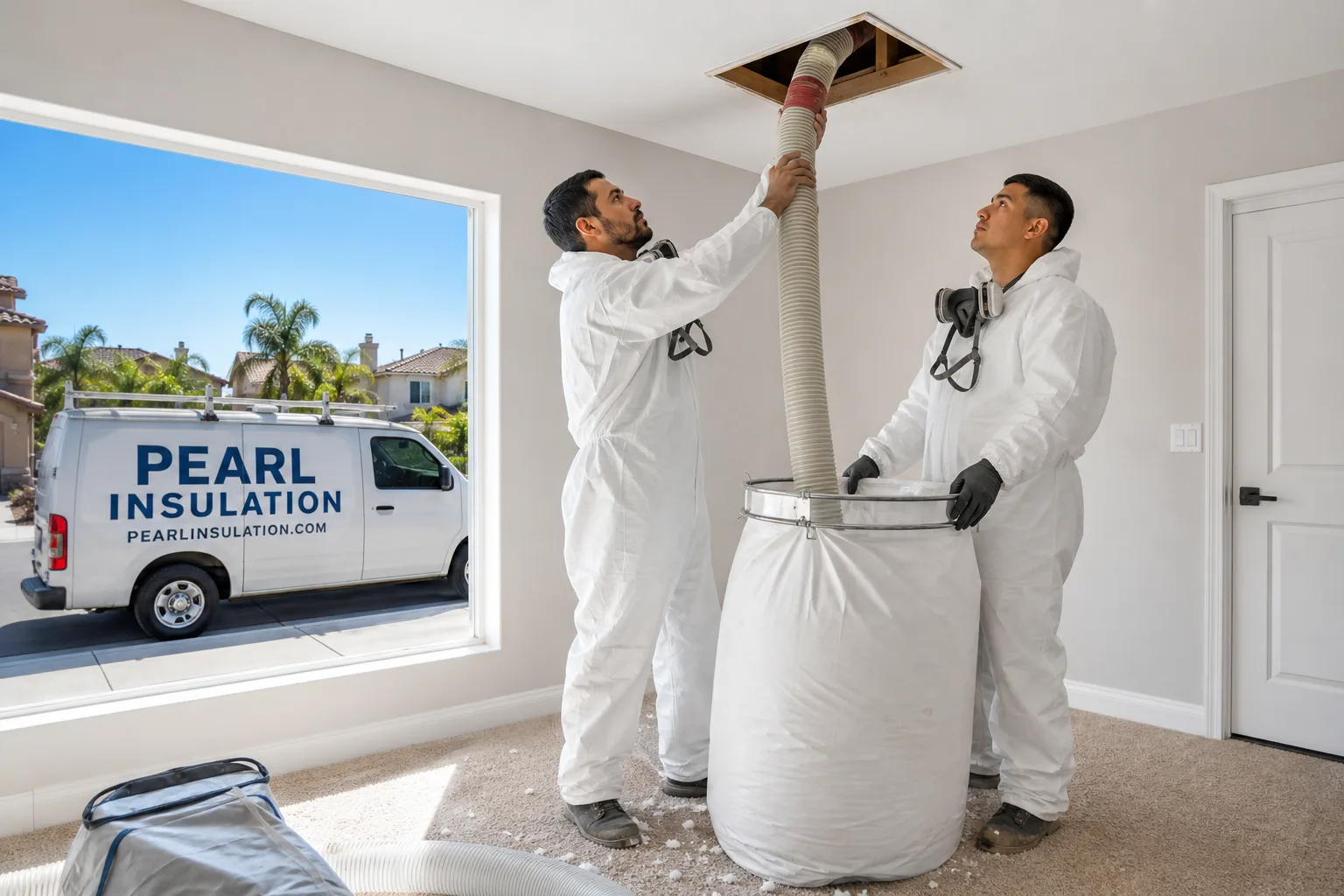
Fast, Reliable Attic Insulation Across Corona
Attic insulation in Corona typically costs $1,800 to $4,600 for a full removal-and-replace, or $1,200 to $2,800 for a top-up and air-seal, and most jobs are finished in one day. That’s the short answer. The longer version matters more: Corona sits at the eastern edge of the LA basin where inland heat pushes attic temperatures past 150°F in summer, and Santa Ana winds pull heat and embers through aging vents all fall. A 1970s tract home off Sixth Street in 92882 fights those conditions very differently than a 2005 two-story backing onto the Temescal Valley hillsides in 92883. We spec them differently too. Call (833) 686-4248 and we’ll tell you which one you have.
Why Pearl Insulation Is Corona’s Preferred Attic Insulation Company
Pearl Insulation is led by Roland Sifuentes, and our single trade is insulation. Not roofing, not HVAC, not general remodeling. That focus means we carry eight competing brands – Owens Corning, Johns Manville, Knauf, Rockwool, CertainTeed, Icynene, Demilec, and GreenFiber – and we recommend based on what your Corona home actually needs. A flat-grid 1970s tract house with a low-pitch attic needs a different assembly than a hillside 2010 build with vaulted ceilings and a wildfire-adjacent lot. Most contractors carry one or two brands and make every house fit them. We don’t.
Corona homeowners call us from 92882, 92883, 92877, and 92878 for the same underlying reason: their upstairs rooms run 10-15° hotter than downstairs, or their AC never cycles off between June and October, or their energy bill doubled since the roofline was replaced. We respond to Corona jobs same-day for diagnostics and usually start installation within the week. Roland has walked attics in the older core near Corona High School and in the newer tracts off Green River Road. The houses are different. The approach should be too.
Insulation Contractors in Corona
Insulation Contractors in Corona deal with a split housing stock that most Southern California cities don’t have. The flat-grid core – 92879, 92882 – is dense with mid-century and 1970s-80s tract homes, many still running original batt insulation that has sagged, compressed, or separated from the ceiling plane. The newer eastern ZIPs – 92880, 92881, 92883 – hold large 1990s-2000s two-story planned-community homes with cathedral ceilings, kneewalls, and attached garages that complicate attic runs. One company’s bid might cover both. One insulation spec should not.
A full attic insulation replacement in Corona runs $1,800 to $4,600 depending on square footage and access. A top-up with air sealing runs $1,200 to $2,800. We quote both methods after looking at your specific attic – not before.
Older Homes, New Problems
Homes built before 1985 in the Corona core often have R-11 to R-19 batt insulation that was marginal on day one and is functionally useless now. The fiberglass separates from the ceiling drywall in the heat, leaving gaps that radiate 100°F+ attic air straight into bedrooms. Many of these attics also lack proper baffles, so whatever insulation is there gets wind-washed by Santa Ana events and breaks down faster.
Hillside Specs, Fire-Edge Details
Homes backing onto the Cleveland National Forest edge in 92881 and 92883 need ember-resistant venting and non-combustible insulation details that coastal Orange County homes never think about. Standard soffit vents become ember intakes during red-flag wind events. We spec rock fiber batts and mineral wool as a fire-safe alternative in these attics, paired with ember-rated vent covers. The thermal goals are similar to the flat grid; the fire considerations are not.
Attic Ventilation in Corona
Attic Ventilation in Corona is not a peripheral add-on. It’s the difference between an attic that holds at 120°F and one that bakes past 160°F in August. The inland Riverside County heat loads attics from above, while Santa Ana winds hit them from the side, pressurizing soffit vents and pulling conditioned air out of the house. Homes in the older core often still have the original static vents, rusted by decades of thermal cycling, too small for the roof area, and completely inadequate for what Corona throws at them.
We include baffles and ventilation prep in every attic job we do in Corona, whether it’s a top-up or a full replacement. A typical ventilation upgrade – swapping rusted 8-inch static vents for ridge venting, adding baffles, sealing top plates – adds $600 to $1,400 to a job. It’s the cheapest performance gain you’ll buy in that attic.
Ridge Venting vs. Static Vents
Most Corona homes built before 1990 have static box vents or no ventilation at all. Those work until the first Santa Ana event, when wind-driven heat gain overpowers them. Ridge venting runs continuously along the roof peak and works with the wind rather than against it. In the flat-grid core, we regularly pair ridge venting with new blown-in ceiling depth to knock 20-30°F off peak attic temperature.
Baffles and Soffit Prep
Attics in Corona’s 1970s-80s tracts often have insulation shoved tight against the roof sheathing at the soffit line, blocking air movement entirely. That turns the attic into a still-air oven. We install baffles before adding any new insulation, so the soffit inlet – ridge outlet cycle actually works. If we don’t do this, the new insulation underperforms from day one.
Trusted Brands We Service in Corona
Pearl Insulation is an authorized installer of eight leading insulation brands: Owens Corning, Johns Manville, Knauf, Rockwool, CertainTeed, Icynene, Demilec, and GreenFiber. For Corona homeowners, that matters because the right spec for a 92882 tract house is not the right spec for a 92883 hillside build. We carry Rockwool for fire-resistance near the Cleveland National Forest edge, CertainTeed for attic batt work in the older grid, and GreenFiber for blown-in ceiling depth across the flat core. We stock materials in Riverside County, so turnaround on Corona jobs is fast – most installations start within 3 to 5 business days of the quote. Call (833) 686-4248 if you want a spec, not a sales pitch.
Common Attic Insulation Problems We See in Corona Homes
- Sagging and separated 1970s-80s batts. In the flat-grid core around 92879 and 92882, original fiberglass batts pull away from the ceiling plane after decades of 150°F attic heat, creating direct radiant paths from roof to room. We see this in about 7 of every 10 homes built before 1985.
- Wind-washed kneewalls in hillside homes. Santa Ana winds pressurize attics and force conditioned air out through kneewall gaps and soffit vents, especially in the two-story tracts off Green River Road and toward 92883. Insulation near the fire edge degrades faster than anywhere else in the county.
- Attached-garage attic transitions leaking heat. The 1990s-2000s planned-community homes in eastern Corona often have attic space over the garage that isn’t properly insulated from the main thermal envelope. Garage heat bleeds into upstairs rooms, and old one-piece garage doors sometimes block safe attic access for a retrofit.
- Missing or collapsed ventilation. Rusted static vents, no baffles at the soffit line, and insulation blocking airflow are standard in Corona’s original housing stock. The attic cooks, the AC strains, and the new insulation you paid for barely moves the needle. Ventilation fixes this.
Pricing for Attic Insulation in Corona, CA
A blown-in top-up with air sealing in Corona runs $1,200 to $2,800 for a typical 1,200-1,800 square foot attic. A full removal-and-replacement job runs $1,800 to $4,600, with hillside homes in 92881/92883 trending toward the upper end because of kneewall work, vaulted ceiling runs, and ember-resistant venting details. Attic baffles and ventilation prep add $600 to $1,400. The two biggest cost drivers are attic accessibility – one-piece garage doors in some 1990s tracts are a real constraint – and how much of the original assembly can stay. Call (833) 686-4248 for a free on-site estimate in Corona, and we’ll give you a line-item number the same day.
We Also Serve Cities Near Corona
Pearl Insulation runs jobs throughout western Riverside County. If you’re in Home Gardens, El Cerrito Corona, Eastvale, or Norco, you’re inside our regular service area. We also handle Attic Insulation calls throughout the Inland Empire and Attic Insulation in Corona has its own set of local specs we’ve refined over years of walking these attics.
Serving Corona, CA — Our Local Coverage Area
We’re based in the Corona area and know this community well. Use the map below to see our service coverage — if you’re nearby, we can almost certainly help.
FAQs About Attic Insulation in Corona
Because the construction is different. A 1970s flat-grid home in 92879 has a low-pitch attic, original batt insulation that has sagged and separated, and undersized static venting. It needs air sealing, baffles, and blown-in ceiling depth brought up to R-49. A 2000s hillside home in 92883 has vaulted ceilings, kneewalls, and wildfire-adjacent exposure, so it needs rock fiber or mineral wool batts in the fire edge, ember-rated vent covers, and careful kneewall detailing. The same spec would fail both houses. Call (833) 686-4248 and we’ll tell you which one you have.
Yes, and more than most homeowners realize. Strong offshore winds pressurize the attic from the exterior, forcing conditioned air out through gaps and pulling hot outside air in. That wind-washing degrades fiberglass batts at the edges and makes air sealing critical. Houses with old static vents suffer the worst because the venting can’t shed the wind-driven heat. We see the damage concentrated on the windward edges of homes across 92878, 92882, and the hillside tracts. If your upstairs rooms spike in temperature during wind events, call (833) 686-4248 for an attic inspection.
We most commonly blow GreenFiber cellulose in Corona attics because it settles into the uneven cavities of older homes better than fiberglass, and it carries a high recycled content. For homeowners who want fiberglass blown-in, we also install Owens Corning and Johns Manville products. The brand isn’t the headline though – the depth is. We spec R-49 for Corona attics in the flat core and R-38 to R-49 on hillside homes depending on the ceiling design. Call (833) 686-4248 for a recommendation specific to your attic.
Yes, but it takes planning. Many 1990s-2000s tracts in eastern Corona have the attic access hatch in the garage ceiling, and a one-piece garage door tracked overhead can block ladder placement. We work around it by staging materials through a gable end or a secondary access point when one exists, or by working in sections with the door open and the garage protected. It’s slower and costs slightly more – usually 10-15% on labor – but it’s routine for us. Call (833) 686-4248 and we’ll tell you if your access works as-is.
Those homes need ember-resistant venting and non-combustible insulation details. Standard soffit vents become ember intakes during red-flag wind events, which is not acceptable on a wildland-interface lot. We install ember-rated vent covers, fire-resistant batt materials like Rockwool or CertainTeed, and avoid combustible insulation near any vented opening. The thermal goal is the same as a flat-grid home. The fire safety overlay is what makes it different, and it’s standard on every job we do in 92881 and 92883 near the forest edge. Call (833) 686-4248 for a hillside-specific proposal.
Written by Roland Sifuentes, Owner at Pearl Insulation, serving Corona since day one.
Ready to get your Corona attic inspected? Call (833) 686-4248 for a free estimate. We’ll walk the attic with you, explain what’s there, what it should be, and what it costs to fix. No pressure, no generic pitch – just a spec that fits your house.