
Fast, Reliable Attic Insulation Across Quail Valley
Attic insulation in Quail Valley isn’t a routine upgrade. It’s the single most effective fix for homes that bake under 100°F+ summer heat and leak conditioned air through attics that can hit 150°F by mid-afternoon. We work on 1980s – 2000s stucco tract homes throughout the 92587 ZIP, where original R-11 and R-13 fiberglass batts have compacted decades past their useful life. That’s why our crews are in Quail Valley weekly, assessing attics, air-sealing bypasses, and installing materials matched to the foothill climate. Call (833) 686-4248 for a free attic assessment.
Why Pearl Insulation Is Quail Valley’s Preferred Attic Insulation Company
Quail Valley homeowners tend to ask sharper questions than most, because they’ve lived through enough summers to know a hot attic isn’t normal. We answer with specifics. Pearl Insulation carries eight insulation brands, including Knauf, Rockwool, and CertainTeed, so a recommendation here is based on what a 1980s stucco home with a tile roof actually needs, not what we happen to stock. We’re a single-trade specialist. Insulation is all we do, which means the crew that shows up in Quail Valley knows how to read compacted batts, rodent damage, and dust-packed eave corners without learning on your ceiling.
Response time to Quail Valley is typically next-day for assessments, and we schedule installations around the hottest weeks because that’s when most homeowners discover their AC can’t hold a setpoint. Our familiarity with the tract layouts off the main foothill roads means we arrive knowing what to expect: tile roofs, attached garages, standard wood-frame attics, and insulation that’s been failing quietly for years. Roland Sifuentes leads our crews, and he’s built the team around one principle: explain the material options honestly, then install the one that fits.
Why 150°F Attics Make Quail Valley Different
Quail Valley sits in the inland foothill belt of the Lake Elsinore Valley, where summer heat regularly exceeds 100°F and attic temperatures climb past 150°F. That’s not a number we quote from a chart. That’s a measured condition on real tile-roof stucco tract homes in the 92587 ZIP. At those temperatures, the original R-11 or R-13 fiberglass batts installed in most 1980s – 2000s homes measurably lose R-value and sag well before their nominal lifespan. Fiberglass loses effectiveness as the temperature differential climbs, and when the batts have also compacted from decades of gravity and foot traffic, the ceiling below becomes a heat exchanger. Add rodents tunneling through the batts near foothill-adjacent properties, plus wind-driven dust packing into the seams, and you get exactly the kind of bare gaps that push heat straight into living space.
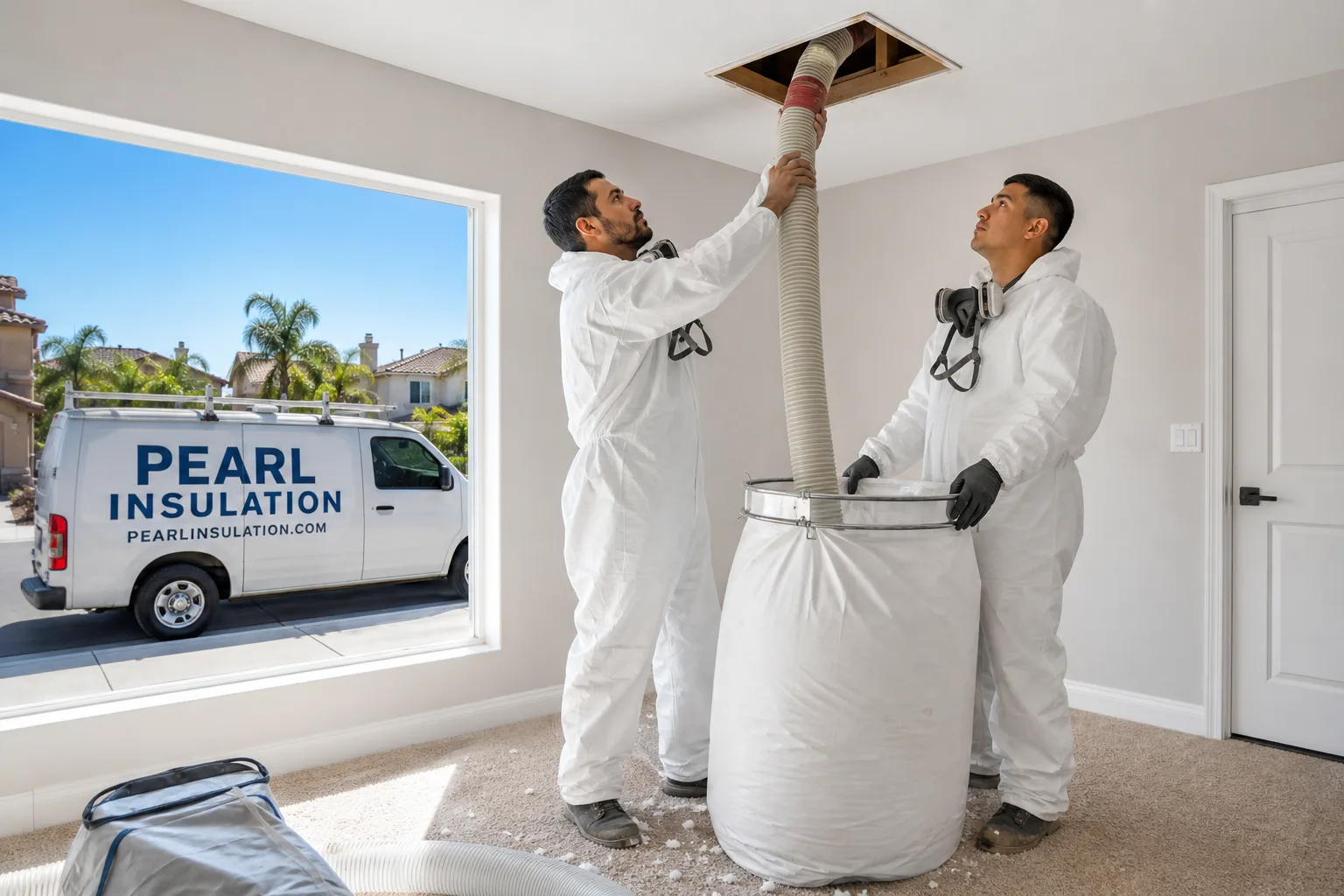
Because Quail Valley’s climate is dry, moisture control matters far less here than sheer R-value and radiant-barrier performance. We rarely recommend heavy vapor-barrier work on Quail Valley attics. The priority is air-sealing first, then restoring a full, even insulation blanket. On a tile-roof stucco tract home off the foothill streets near ZIP 92587, our crew opened the attic hatch on a 100°F+ afternoon and found the original fiberglass batts collapsed to roughly half their intended depth, with rodent-tunneled sections and wind-driven dust compacted into the corners. We air-sealed the top plates and bypasses, then blew in GreenFiber cellulose to restore a full, even blanket over the settled batts. The homeowner reported the upstairs rooms finally holding their set temperature through the peak afternoon instead of running the AC nonstop. That’s the outcome we aim for on every Attic Insulation in Quail Valley job.
Attic Ventilation in Quail Valley
Attic Ventilation in Quail Valley isn’t optional hardware. It’s how a 150°F attic sheds heat instead of cooking your insulation and your ceiling. Most 1980s – 2000s tract homes here were built with minimal soffit and ridge venting, and tile roofs complicate airflow because they don’t release heat the way composite shingles do. When ventilation is inadequate, the attic becomes a pressure cooker, and even new insulation underperforms. A Quail Valley homeowner needs attic ventilation addressed when upstairs rooms stay hot after sunset, when cooling bills climb despite adequate insulation levels, or when the attic smells stale and hot during shoulder seasons.
A typical attic ventilation project in Quail Valley runs $450 – $1,200 depending on attic size, roof configuration, and whether we’re adding soffit vents, a ridge vent, or powered ventilation. Tile roofs require careful flashing work, which we handle in-house. The goal is balanced airflow: intake at the eaves, exhaust at or near the ridge.
Soffit and Ridge Vent Installation
Most Quail Valley homes need more intake area than they have. We cut new soffit vents and pair them with a continuous ridge vent where the roof line allows. On tile roofs, this means removing and reinstalling tiles along the ridge path. Done correctly, the attic temperature drops 20 – 30°F within an hour of the afternoon peak, which directly extends the life of whatever insulation sits below it.
Powered Attic Fans for Existing Roofs
When adding ridge venting isn’t practical on an older Quail Valley roof, we install thermostatically controlled attic fans. These mount at the gable or roof deck and move hot air out when the attic hits a set temperature. For homes already at 150°F by 2 p.m., a fan can cut that by 25 – 40°F, which reduces the load on your AC and keeps blown-in insulation from baking.
Radiant Barrier in Quail Valley
Radiant Barrier in Quail Valley works because the sun pounds tile roofs for 10 – 12 hours a day in summer, and radiant heat transfers downward through the roof deck into the attic. A radiant barrier is a reflective material, usually foil-faced, installed on the underside of the roof rafters. It reflects radiant heat back toward the roof instead of letting it radiate onto the attic floor and the insulation below. In a 150°F attic, a properly installed radiant barrier can reduce the ceiling heat gain by 15 – 25%, which is meaningful on days when your AC is already struggling.
A radiant barrier installation in Quail Valley typically runs $0.90 – $1.60 per square foot of attic floor area, installed. For a typical 1,800-square-foot single-story stucco home, that puts the project in the $1,600 – $2,900 range. We install it as part of a broader Attic Insulation package or as a standalone upgrade. The key in Quail Valley’s dry climate is that the reflective surface stays clean and effective; dust accumulation is the main long-term concern, and our installs are positioned to minimize it.
Stapled Foil on Rafters
The standard method for Quail Valley’s wood-frame attics is stapling a double-sided foil radiant barrier to the underside of the rafters. This creates a reflective air gap facing the roof deck. It’s most effective in homes where the attic is unconditioned and the ductwork or air handler runs through the attic space, which is common in 1980s – 2000s tract builds here.
Radiant Barrier with New Blown-In Insulation
We often combine radiant barrier with blown-in cellulose or fiberglass in Quail Valley attics. The barrier handles the radiant component of the heat load. The blown-in material handles the conductive component. Together they address the two separate ways heat enters a home, which is why this combination consistently produces the largest cooling bill reductions we see in the 92587 ZIP.
Trusted Brands We Service in Quail Valley
We stock and install Knauf fiberglass, Rockwool mineral wool, and CertainTeed insulation products for Quail Valley customers, alongside our full line of Icynene spray foam and GreenFiber cellulose. That breadth matters in a market like Quail Valley, where a 1985 tract home with settled batts needs a different solution than a 2005 home with a tile roof and above-average attic heat. We carry competing brands because no single product wins every job. For Quail Valley customers, that means fast turnaround without waiting on a special order, and recommendations driven by the home’s age, attic condition, and cooling goals rather than by supplier convenience.
Common Attic Insulation Problems We See in Quail Valley Homes
- Compacted R-11 and R-13 batts. Original fiberglass batts in 1980s – 2000s stucco tract homes settle to half their intended depth over 20 – 40 years. The hottest ceiling areas end up with the least insulation, right when 150°F+ attic temps demand the most R-value.
- Rodent damage in foothill-adjacent attics. Rats and mice tunnel through fiberglass batts and flatten them into bare gaps. Our crews regularly find bare spots above bedrooms that channel heat straight down into living space.
- Wind-driven dust packed into seams. The dry foothill winds push fine dust through eave vents and into batt seams and corners. That dust compacts the insulation and hides thin spots until a cooling complaint finally reveals them.
- Inadequate attic ventilation. Many Quail Valley homes were built with minimal soffit venting, and tile roofs trap heat. The attic becomes a heat reservoir that re-radiates into the home long after sunset, even with adequate insulation depth.
Pricing for Attic Insulation in Quail Valley, CA
Attic insulation pricing in Quail Valley depends mainly on attic square footage, current insulation depth, and the material we recommend. Blown-in cellulose or fiberglass for a typical 1,500 – 2,000-square-foot home runs $1,800 – $3,400 installed. Attic batt insulation for the same footprint runs $2,200 – $4,000 depending on R-value. A top-up over existing settled batts runs $1,200 – $2,200. Full removal and replacement, which we recommend when rodent damage or heavy dust contamination is present, runs $3,500 – $6,500. Radiant barrier adds $0.90 – $1.60 per square foot. Ventilation work runs $450 – $1,200 as a separate line item. Call (833) 686-4248 for a free estimate with exact numbers for your attic.
We Also Serve Cities Near Quail Valley
Beyond Quail Valley, our crews regularly work in Quail Valley and the surrounding Lake Elsinore Valley communities. We cover Sun City, Canyon Lake, Meadowbrook, and Romoland with the same next-day assessment scheduling and the same brand access across Knauf, Rockwool, CertainTeed, Icynene, and GreenFiber. If you live just over the city line, call us: the foothill heat doesn’t stop at a ZIP code boundary.
Serving Quail Valley, CA — Our Local Coverage Area
We’re based in the Quail Valley area and know this community well. Use the map below to see our service coverage — if you’re nearby, we can almost certainly help.
FAQs About Attic Insulation in Quail Valley
Quail Valley sits inland in the foothill belt, so summer attic temperatures routinely exceed 150°F, while coastal cities 30 – 40 miles west stay 30 – 50 degrees cooler at the roofline. That heat differential means the same R-value performs differently in Quail Valley than it would in Oceanside or Carlsbad. The insulation has a harder job here, so depth, air-sealing, and radiant barriers matter more than they do near the coast. Call (833) 686-4248 and we’ll explain what your specific attic needs for this climate.
Almost certainly not to its original R-value. Fiberglass batts installed in 1990s Quail Valley tract homes were typically R-11 or R-13, and after 25 – 35 years of heat, gravity, and rodent traffic, they’re usually compacted to half their intended depth in the hottest areas. We recommend an attic assessment before assuming the original insulation is still doing its job. The assessment is free.
No. Quail Valley’s climate is dry, with hot summers and mild winters, so vapor barriers are less critical than in coastal or humid climates. The priority here is air-sealing and R-value depth. We skip vapor-barrier work on most Quail Valley attics and put the budget toward blown-in insulation and radiant barrier, which address the real problem: 150°F attic heat.
For most Quail Valley homes, blown-in cellulose is the better choice because it fills gaps and covers settled batts evenly. It performs well in high heat, resists rodent tunneling better than loose fiberglass, and works with the air-sealing we do first. Fiberglass batts still have a place in new construction or accessible attics where we’re starting from a clean deck. We’ll recommend the one that fits your attic’s condition, not the one that’s easiest to quote. Call (833) 686-4248 for our take on your specific attic.
Yes, if your attic regularly hits 130°F or more, which most Quail Valley attics do from June through September. Radiant barrier and blown-in insulation solve different problems: the barrier reflects radiant heat, the insulation slows conductive heat. Doing both in a 92587 home typically produces better cooling bill results than doing either one alone. We’ll give you straight numbers for both options during a free estimate.
Written by Roland Sifuentes, Owner at Pearl Insulation, serving Quail Valley and the Lake Elsinore Valley since day one.