
Fast, Reliable Attic Insulation Across Rancho Mirage
Attic insulation in Rancho Mirage isn’t a heating problem. It’s a cooling problem. When your attic hits 150°F at 3 p.m. in August, the question isn’t whether you’ll be uncomfortable. It’s how long your AC can keep up before it burns out. We respond to Rancho Mirage calls fast because we know exactly what these homes are fighting: shallow flat-roof cavities, original 70s and 80s batt insulation that’s given up, and recessed-can lights that pump superheated attic air straight into your living room. If your house was built during the country-club boom and you’re still running original insulation, you’re paying for cool air that never reaches you. Call (833) 686-4248 and we’ll tell you what’s actually happening up there.
Why Pearl Insulation Is Rancho Mirage’s Attic Insulation Company
Rancho Mirage homeowners call us after other contractors have already been out. That’s not a brag; it’s just what happens when you’re the only crew in the valley carrying eight insulation brands instead of pushing one. We’ve worked in gated communities along Frank Sinatra Drive, in the low-pitch 1980s tracts off Bob Hope Drive, and in the flat-roofed mid-century builds around Mission Hills Country Club. Roland Sifuentes built Pearl Insulation around a simple idea: a home’s age, roof shape, and existing ductwork should decide the material, not what’s cheapest to source that week. That’s why we stock Owens Corning, Johns Manville, Knauf, CertainTeed, Rockwool, GreenFiber, Icynene, and Demilec. No other local crew gives a Rancho Mirage homeowner that range of honest options.
We’re not a general contractor who treats insulation as line item six. Attic insulation is what we do. That focus means our team knows that a 1984 flat-roof off Country Club Drive needs a different sequence than a 1992 tract home near The Springs: air sealing first, then material, then ventilation. The result is a job that actually changes how the house feels, not one that just checks a box. Rancho Mirage customers don’t need another contractor to come back and explain why the last guy’s work didn’t hold. They need the right fix the first time.
Insulation Contractors in Rancho Mirage
Insulation contractors in Rancho Mirage get called when the AC runs all day and the living room still climbs past 80°F by mid-afternoon. That’s the signature failure mode of this city’s housing stock. The job starts with heat-blocking air sealing, not insulation. In a 1980s flat-roof home off Frank Sinatra Drive, our crew found superheated air pouring through unsealed recessed cans into a living room that hit 88°F by 2 p.m. despite a newer AC. We heat-blocked the cans with fire-rated enclosures, air-sealed the top plates, then blew GreenFiber to R-38 and added a radiant barrier. The room dropped 9°F on the next 112°F day. That’s the sequence that works here, and most Rancho Mirage homes need exactly that order.
Air Sealing Before R-Value
In Rancho Mirage’s shallow flat-roof attics, recessed can lights act as chimneys. They pull 150°F+ attic air directly into living rooms. Adding insulation without sealing them makes the heat penetration worse because the new insulation presses more hot air through whatever gaps remain. We seal around every can with fire-rated enclosures and seal top plates before we add a single inch of material. Any contractor who skips this step is selling you insulation that cannot work.
Blown-In and Rigid Board Retrofits
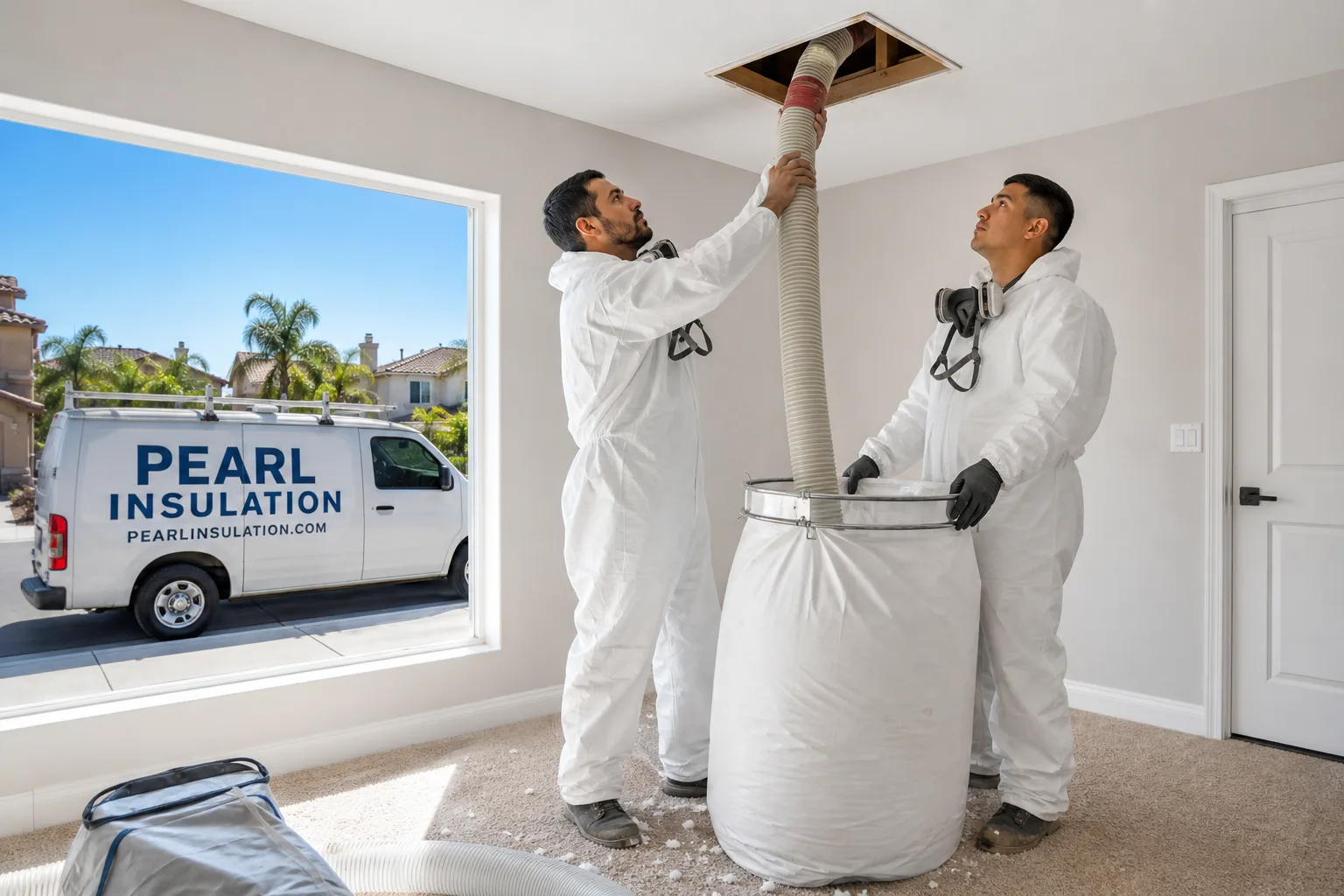
Most Rancho Mirage attics have almost no crawl space. That rules out standard batt work in a lot of these homes. We run blown-in cellulose or fiberglass through tight flat-roof cavities, and we use rigid board where the deck sits too low for anything else. These retrofits get the material where it matters without tearing into finished ceilings. If your attic has less than 18 inches of clearance, blown-in is usually the answer.
Attic Ventilation in Rancho Mirage
Attic ventilation in Rancho Mirage is the difference between an attic that hits 150°F and one that stays under 120°F. In a cooling-dominated climate like this, ventilation isn’t optional. It’s the first line of defense against a superheated attic turning your ceiling into a radiant heater. Many 1970s and 80s Rancho Mirage homes have original passive vents that were undersized even when they were installed. Four decades of desert heat cycles have not improved them. We evaluate every attic for airflow before recommending insulation, because adding R-value to an unventilated low-pitch attic just bakes the material and shortens its life.
Baffles and Airflow in Low-Pitch Roofs
Low-pitch and flat roofs don’t give air much room to move. That’s why baffles matter so much in Rancho Mirage. They keep blown-in material from blocking the soffit vents and maintain a narrow air channel under the deck. Without them, the insulation suffocates the ventilation, and the attic heat has nowhere to go. We install baffles in every cavity where airflow is restricted, especially on the shallow flat-roof builds where clearance is minimal.
Radiant Barriers for Desert Heat
A radiant barrier reflects heat before it ever enters the attic. In Rancho Mirage, where the sun punishes your roof deck from June through October, a radiant barrier can cut attic temperatures by 20°F to 30°F on a 115°F day. It’s not a substitute for insulation; it’s a companion to it. We staple radiant barrier to the underside of the roof deck on homes where the attic is too shallow for deep insulation. The barrier does the heat-blocking work that R-value alone can’t handle in a flat-roof cavity.
Trusted Brands We Service in Rancho Mirage
We carry Knauf, Rockwool, CertainTeed, and Icynene because no single brand solves every Rancho Mirage home’s problem. Knauf blown-in fiberglass works well in tight flat-roof cavities where batts can’t go. Rockwool gives you fire resistance and sound control for the walls adjacent to a hot attic. CertainTeed batts make sense in the few Rancho Mirage attics with enough clearance for traditional installs. And Icynene spray foam is the right call when air sealing and insulation need to happen simultaneously in a shallow deck cavity. We keep local stock for Rancho Mirage jobs so we’re not waiting on a warehouse in Riverside when your attic needs work now. For full details on our Attic Insulation approach, see our service overview.
Common Attic Insulation Problems We See in Rancho Mirage Homes
- Original recessed-can lights acting as heat chimneys. In a 1980s flat-roof home off Frank Sinatra or Bob Hope Drive, those original cans were never sealed. They pull 150°F+ attic air straight into the living room every summer afternoon, and no amount of new insulation fixes that until the cans are heat-blocked.
- Compacted 1970s and 80s batt insulation that’s lost its R-value. Extreme heat cycles in Rancho Mirage sag and compress original fiberglass batts. A batt labeled R-19 in 1984 might be performing at R-9 today, and the ducts above it are sitting in a 150°F attic with almost no protection.
- Shallow flat-roof attics that rule out standard batt installation. Country-club tract homes and desert contemporary builds often have less than 18 inches of attic clearance. That forces blown-in or rigid board retrofits, and installers who skip a radiant barrier leave the cooling load basically unchanged because the deck still radiates heat into the house.
- Undersized original passive ventilation. Many Rancho Mirage attics have soffit and gable vents that were built for a milder climate. In a desert summer, those vents don’t move enough air to keep the attic out of the danger zone for your HVAC ductwork.
Pricing for Attic Insulation in Rancho Mirage, CA
A typical attic insulation job in Rancho Mirage runs $1,800 to $4,200, depending on attic size, clearance, and what’s already up there. Blown-in cellulose or fiberglass in a 2,000-square-foot flat-roof home usually lands between $2,200 and $3,800, including air sealing around recessed cans. Radiant barrier installation adds $800 to $1,600 on most low-pitch roofs. Attic ventilation work, including baffles and new passive or powered vents, typically runs $400 to $1,200. If your original insulation has compacted and needs full removal before we add new material, expect removal to add $600 to $1,400. These are real ranges for Rancho Mirage’s housing stock, not national averages. Every job gets a written quote before we start. Call (833) 686-4248 to schedule a free estimate and we’ll measure your specific attic.
We serve all of Rancho Mirage including every neighborhood in the 92270 ZIP.
We Also Serve Cities Near Rancho Mirage
Pearl Insulation runs crews across the Coachella Valley. We’re regularly in Cathedral City, Palm Springs, Garnet, and Idyllwild, and respond to those areas with the same desert-climate expertise we bring to Rancho Mirage. If you’re in a neighboring community and your attic is baking, call us at (833) 686-4248 and we’ll get a crew scheduled.
Serving Rancho Mirage, CA — Our Local Coverage Area
We’re based in the Rancho Mirage area and know this community well. Use the map below to see our service coverage — if you’re nearby, we can almost certainly help.
FAQs About Attic Insulation in Rancho Mirage
Because the heat isn’t coming through the insulation. In most Rancho Mirage flat-roof homes, it’s pouring through unsealed recessed-can lights that act as chimneys, pulling 150°F attic air directly into the living space. Insulation added without sealing those cans first makes the problem worse, not better. We air-seal every can with fire-rated enclosures and seal top plates before any material goes in. Call (833) 686-4248 and we’ll diagnose what’s actually heating your living room.
R-38 is the right target for most Rancho Mirage attics, including 1980s low-pitch builds. In a shallow flat-roof cavity where R-38 blown-in material won’t fit, we pair R-30 with a radiant barrier to hit the same cooling performance. The exact number depends on your cavity depth and whether ducts run through the attic, but R-38 is the standard we aim for in this climate.
Yes. We heat-block original recessed cans with fire-rated enclosures that seal the fixture and restore the thermal boundary. That means you keep the lights, we remove the leak. This is standard practice on Rancho Mirage homes where replacing every can isn’t practical or wanted. The enclosure goes in, the air gap closes, and the superheated attic air stays in the attic.
Yes. For low-clearance Rancho Mirage attics, we use slim-profile baffles and low-clearance vents designed for flat and low-pitch roofs. We don’t need a tall attic to move air. The key is maintaining the air channel between the insulation and the roof deck, and we do that with baffles sized for your specific cavity depth.
You protect them by changing the attic environment. We air-seal, add insulation at R-38 or higher, install a radiant barrier where the roof geometry allows, and make sure ventilation moves enough air to keep the attic out of that 150°F zone. A duct sitting in a 120°F attic loses far less cooling than one in a 150°F attic. That’s the whole job, and it’s the only way to stop your AC from working against itself.
Written by Roland Sifuentes, Owner at Pearl Insulation, serving Rancho Mirage and the Coachella Valley.