
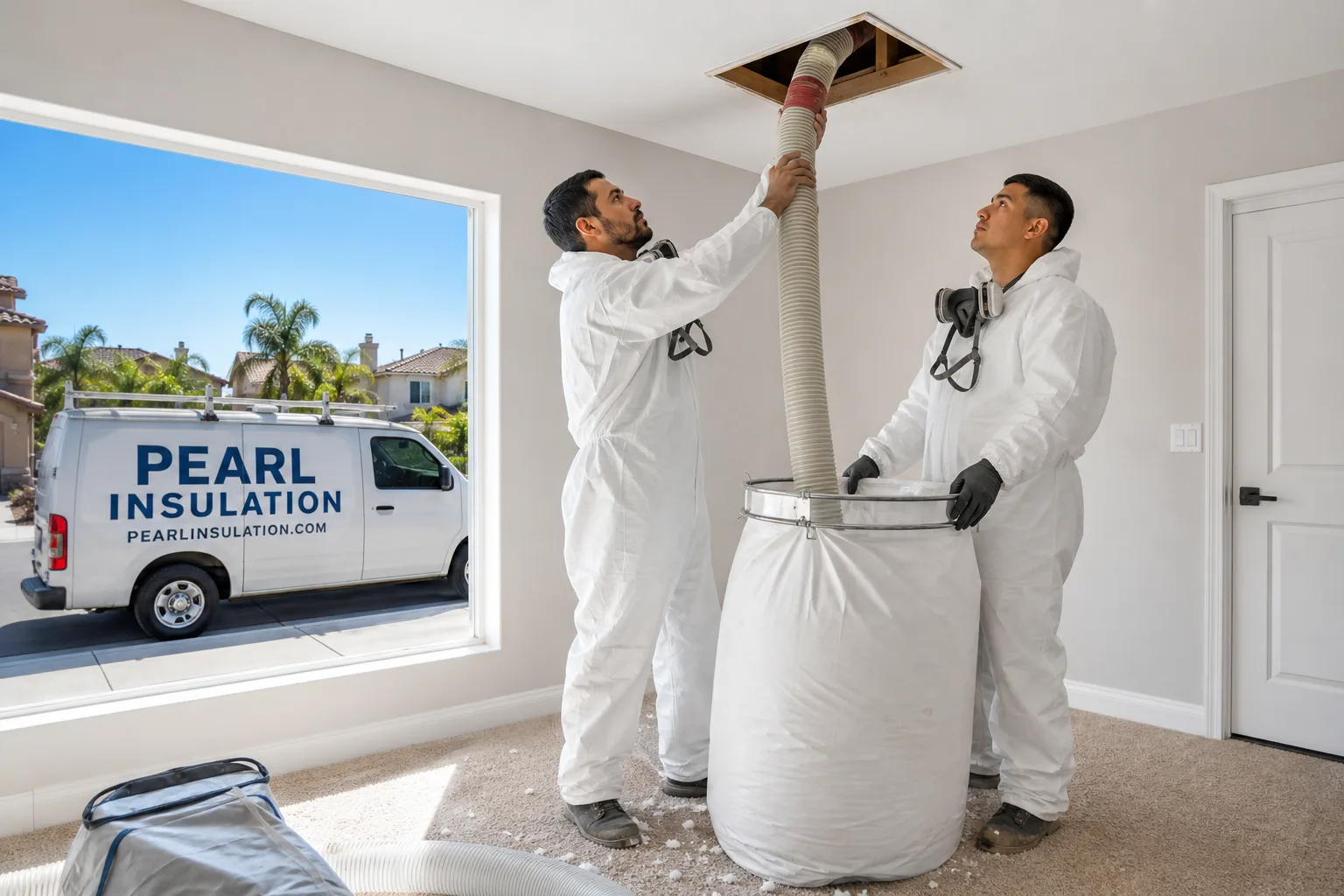
Fast, Reliable Spray Foam Insulation Across Orange
Spray foam insulation in Orange typically costs $2.50 to $7.00 per square foot installed, with most whole-attic jobs landing between $3,800 and $9,500 depending on foam type and square footage. We run crews into Orange five days a week, and most projects are scheduled within 7 to 10 days of your estimate. If you’re tired of a hot upstairs, a drafty living room, or an HVAC system that runs constantly from June through October, call us at (833) 686-4248 and we’ll walk you through what makes sense for your house.
We know Orange not as another stop on the 55, but as a city with two very different housing stocks. Old Towne’s Craftsman bungalows and Spanish Colonials were built before insulation was even a concept. The tract homes that rolled out across the 92865 and 92866 zip codes in the 1950s and 60s got a thin layer of fiberglass that has long since settled into something closer to a blanket than a thermal barrier. Both need spray foam. They need it applied differently. That distinction is where most insulation contractors fall short, and it’s exactly where we spend our time.
Call (833) 686-4248 for a free estimate. We’ll send someone who can talk R-values, foam chemistry, and Orange design review requirements in the same conversation.
Why Pearl Insulation Is Orange’s Preferred Spray Foam Insulation Company
Pearl Insulation is an authorized installer for both Icynene and Demilec, the two spray foam systems most specified on high-performance residential builds and commercial projects. That matters in Orange because it means we can offer honest closed-cell versus open-cell comparisons without pushing whatever is cheapest to source that week. Most local installers carry one line. We carry competing brands because no single product wins every job, and Orange’s housing stock proves that daily.
Roland Sifuentes founded Pearl Insulation with a simple operating rule: insulation is the one upgrade that works every hour of every day, so the material choice should be treated as a permanent decision, not a line item. That philosophy drives how we approach every Orange project, from a 900-square-foot Old Towne bungalow to a 1,800-square-foot tract home off Tustin Avenue. We are an insulation-only shop. We don’t do HVAC, roofing, or general remodeling, which means when we tell you a certain foam density or application method fits your walls, it’s because we’ve spent years studying exactly that.
Our crews know which Orange neighborhoods have knob-and-tube wiring that hasn’t been updated, which mid-century tracts have stucco with failing paper backing, and which Old Towne streets fall under the strictest design-review rules. That local familiarity saves you time on inspection issues and design complications before they become change orders.
Spray Foam Attic Insulation in Orange
Spray foam attic insulation in Orange is the single highest-impact upgrade for older homes here, especially in the uninsulated attics of Old Towne and the settled-fiberglass attics of 1950s-era tracts. A full attic spray foam job in Orange runs $4,200 to $8,800 for most homes between 1,200 and 2,400 square feet. We apply closed-cell foam directly to the roofline when you want a sealed, conditioned attic, or open-cell foam when you’re primarily targeting air infiltration and noise at a lower price point.
What drives cost here is access and old wiring. In Old Towne homes with knob-and-tube, we have to isolate and sometimes route around live circuits before foam touches anything. In tract homes, the work goes faster, but we often find original fiberglass that has compressed to half its rated R-value. Either way, the foam solution should be chosen for how the attic space works – not just what a product sheet says.
Closed-Cell Roofline Applications
Closed-cell foam along the Orange roofline turns the attic into conditioned space, which means the air you pay to cool stops escaping through a 140-degree attic in August. This is the right call for homes where ductwork runs through the attic and you want to stop losing cooled air before it reaches the rooms.
Open-Cell for Air Sealing and Sound
Open-cell foam is softer, expands more aggressively, and does excellent work at filling irregular cavities in older Orange framing. For attics that just need an air-sealing upgrade and modest R-value gains, it’s the more affordable path. We’ve done a number of Old Towne attics where open-cell was the only product that could get into every gap without stressing original plaster from above.
Spray Foam Wall Insulation in Orange
Spray foam wall insulation in Orange splits into two very different jobs: cavity injection in Old Towne’s historic homes and direct-to-stucco or open-cavity retrofit in the mid-century tracts. Wall foam runs $3.50 to $6.50 per square foot of wall area in Orange, with historic retrofit work trending toward the higher end because access is slower and the inspection requirements are tighter. Homeowners in the 92866 and 92867 zip codes should expect to spend $5,500 to $12,000 to insulate all exterior walls, depending on home size and wall construction.
What makes Orange different from Villa Park or Tustin is the design-review layer. Old Towne’s historic district does not allow exterior rigid foam or re-sheathing that changes the facade. Foam has to go through the attic and wall cavities, which is a slower, more specialized process than blowing fiberglass into a stud bay. We’ve built our entire Orange approach around that constraint.
Cavity Injection for Historic Walls
In lath-and-plaster walls, we drill small injection points from the interior and pump closed-cell foam into the cavities at controlled pressure. Done correctly, it fills the void without cracking the plaster or bulging the walls. Done carelessly, it’s how historic plaster gets destroyed. We’ve seen both outcomes in Orange homes, and the difference is always the installer’s experience with old-wall physics.
Stucco Wall Retrofit for Tract Homes
For 1950s and 60s tract homes, the challenge is moisture. Older Orange stucco often has failing building paper behind it, and spraying foam directly against unsealed stucco can trap water and feed mold. We inspect the stucco condition and sealing first, then recommend either a cavity injection or a closed-cell application that leaves a drainage plane intact. This step gets skipped by a lot of crews and it’s the step that determines whether you save money or create a rot problem.
Trusted Brands We Service in Orange
We carry Icynene and Demilec spray foam systems because they solve different problems. Icynene’s open-cell formulations expand aggressively and do exceptional air-sealing work in old Orange attics with irregular framing and odd cavities. Demilec’s closed-cell products deliver higher R-value per inch and structural rigidity, which matters on roofline applications and in stucco wall retrofits where moisture management is critical. We also carry Rockwool and CertainTeed product lines for Orange homeowners who prefer a batt-and-roll approach in some areas of the home. When you call us, you get a material recommendation based on how your specific house behaves – not on what a single-brand shop happens to stock.
Common Spray Foam Insulation Problems We See in Orange Homes
- Knob-and-tube wiring buried under foam. In Old Towne homes that never rewired, we regularly find active knob-and-tube circuits in walls and attics. Foam applied directly over those conductors creates a fire hazard and will fail inspection. We isolate every affected circuit before foam touches any surface.
- Plaster cracking from uncontrolled foam expansion. Closed-cell foam cures at high pressure, and in lath-and-plaster walls that pressure can detach plaster keys and crack original finishes. The fix is slow-rise foam, smaller injection points, and a tech who knows how old plaster responds to load. We’ve corrected several botched Old Towne jobs where the original installer treated a 1910 wall like a 1990 drywall cavity.
- Moisture trapped in unsealed stucco assemblies. Mid-century Orange tract homes often have stucco with degraded paper backing and no drainage plane. Foam applied directly against that stucco interior traps moisture and feeds mold in a single season. This is the most common failure we correct in tract neighborhoods around Orange, and it’s almost always the result of skipping the moisture assessment.
- Low-quality open-cell foam that shrinks. We’ve pulled out foam jobs in Orange that had shrunk away from the framing within eighteen months, usually because the installer used an off-brand open-cell product or mis-mixed the chemicals. Icynene and Demilec formulations cure stable and hold their R-value for the life of the home. That’s why we spec them for every Orange job.
Pricing for Spray Foam Insulation in Orange, CA
For Orange specifically, here’s what we see on typical jobs: open-cell attic foam runs $2.50 to $4.25 per square foot, closed-cell attic foam runs $4.00 to $7.00 per square foot, and wall cavity injection runs $3.50 to $6.50 per square foot of wall area. A 1,500-square-foot tract home getting full attic and wall treatment typically lands between $7,000 and $14,000. Old Towne historic homes trend toward the higher end because access is slower and injection work through lath-and-plaster takes more labor hours. What changes your number most is foam type, square footage, access difficulty, and whether knob-and-tube isolation is required. Call (833) 686-4248 and we’ll give you an exact quote after a site visit. Estimates are free and take about an hour.
We also carry open-cell and closed-cell options across both Icynene and Demilec, so we can adjust the material spec to your actual performance goals rather than forcing a single product line into every Orange home. That means you may pay less, or you may pay more for a better roofline seal, but you’ll know exactly why before work begins.
How Orange’s Historic Design Review Changes the Insulation Game
In Orange’s Old Towne historic district, exterior insulation changes and alterations must clear design-review standards before work starts. That is not a suggestion. The city’s review process protects the visual character of its oldest neighborhoods, which means spray foam crews cannot add exterior rigid foam, cannot re-sheath, and cannot alter facade profiles with furring strips or new cladding. Work has to go through the attic and the wall-and-floor voids instead. That single constraint reshapes how a competent contractor approaches every Old Towne insulation job, and it’s the main reason Orange’s spray foam work looks different from what you’d see in Santa Ana or Tustin, where exterior retrofits face far less scrutiny.
The practical consequence: in Old Towne, we spec closed-cell cavity injection through small interior drill points, then patch and repaint to match the original wall. The cavity seals tight, the facade stays untouched, and the home keeps its historic envelope. That’s not the cheapest way to insulate. It’s the only way that doesn’t trigger a design-review fight and a stop-work order. Any contractor who tells you they’ll wrap a historic bungalow in exterior foam is either unfamiliar with Orange’s rules or planning to deal with the violation after the check clears. We don’t do that.
We recently sprayed closed-cell foam in the attic of a 1912 Craftsman on North Pine Street in Old Towne. The original lath-and-plaster walls had no insulation, and the homeowner wanted to avoid any exterior change that would trigger design review. Our techs injected Icynene foam through small holes drilled from the interior, sealing the wall voids and adding R-13 without altering the historic facade. The homeowner stayed in the house while we worked. The facade looks exactly as it did in 1912, except now the walls actually insulate. That’s the type of Orange project we take on that most general contractors turn down.
Santa Ana Wind, Smoke Sealing, and the Orange Microclimate
Orange sits in the inland North County basin behind the Santa Ana Mountains, with hot, dry summers and mild winters. The load here isn’t heavy heating-season insulation. It’s radiant heat gain through attics and air infiltration through old wall assemblies. During Santa Ana wind events and wildfire-season smoke, those same leaky walls pull in dust, ash, and particulate from the San Bernardino mountains, Orangethorpe corridor, and the 55. A properly sealed spray foam enclosure reduces that infiltration dramatically. It won’t make your home an airlock, but it will make a measurable difference in indoor air quality during the worst smoke days. Combine the foam with good attic ventilation and you’ve addressed the two biggest thermal and air-quality weaknesses in Orange’s older housing stock.
In mid-century tracts across 92865 and 92866, the original fiberglass attic insulation has settled to roughly R-19 to R-25 effective, well below the Title 24 target of R-38 to R-49 for attics in this climate zone. Closed-cell foam along the roofline corrects that gap in one application and eliminates the venting complexities that come with adding more conventional batt over old ducts and wiring. It’s the more expensive route, but it’s the one that actually solves the summer heat problem in those homes.
We Also Serve Cities Near Orange
Pearl Insulation runs daily crews into Orange from our Temecula base, and the same team covers Spray Foam Insulation work in Villa Park, North Tustin, Tustin, and Santa Ana. If you’re in one of those neighboring cities and dealing with similar old-home or tract-home insulation problems, call (833) 686-4248 and we’ll schedule you on the next available route. We group Orange-area jobs geographically to keep response times down and estimates free of travel pricing games.
Serving Orange, CA — Our Local Coverage Area
We’re based in the Orange area and know this community well. Use the map below to see our service coverage — if you’re nearby, we can almost certainly help.
FAQs About Spray Foam Insulation in Orange
Yes. We inject closed-cell foam through small interior drill points that get patched and repainted, which means the exterior facade never changes and design review is not triggered. This is the standard approach for Old Towne’s Craftsman, Spanish Colonial, and early twentieth-century homes. Call (833) 686-4248 for a facade-safe wall insulation assessment.
Closed-cell foam installed with a proper drainage plane behind the stucco is the right solution for most 1950s and 60s Orange tract homes. We inspect the existing stucco and building paper first, because trapping moisture behind foam creates mold and stucco failure within a season. Call (833) 686-4248 and we’ll tell you exactly what your stucco assembly needs before any foam is ordered.
Spray foam air-sealing cuts the infiltration paths where Santa Ana winds push smoke, ash, and dust into Orange homes through wall cavities, rim joists, and attic gaps. The reduction in indoor particulate is noticeable on the worst smoke days, especially in older homes that never had continuous air sealing. Estimate the project at (833) 686-4248.
No. We inject slow-rise closed-cell foam through small drilled holes in the plaster, fill the wall cavities, and patch each injection point. The lath and plaster stay intact. Removing them would trigger far more extensive work, change the wall dimensions, and destroy the historic interior character. This is the primary reason we spec cavity injection over other wall insulation methods in Old Towne.
We install Icynene and Demilec spray foam systems, both of which are specified in high-performance and new-construction residential builds. Icynene open-cell is our default for old-house air sealing, while Demilec closed-cell gets the call on rooflines and stucco wall retrofits where higher R-value and moisture management matter. Your Orange home gets the brand that fits its actual construction, not whichever system we stock in bulk.
Written by Roland Sifuentes, Owner at Pearl Insulation, serving Orange and surrounding North County communities.